
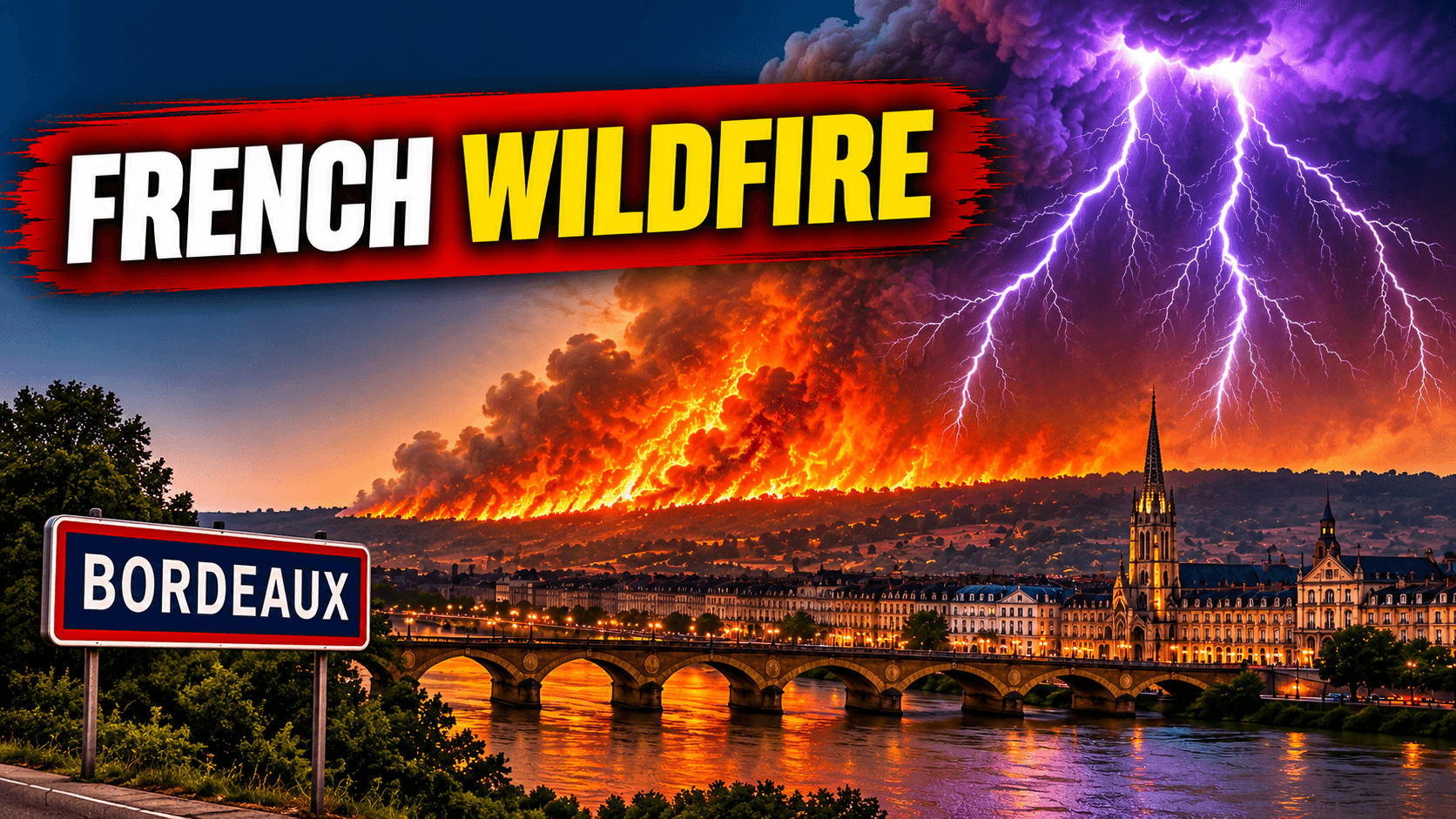
French Wildfire Creates Lightning Storm as Massive Blaze Threatens Bordeaux
A massive wildfire raging in southwestern France has created a rare fire-generated thunderstorm, producing lightning, powerful winds, and highly unpredictable fire behavior as flames continue to threaten the city of Bordeaux.
Siddhaanth Raghav
French Wildfire Creates Lightning Storm as Massive Blaze Threatens Bordeaux
Rare Fire-Generated Thunderstorm Complicates Firefighting Efforts as Thousands Remain Evacuated
A massive wildfire raging in southwestern France has created a rare fire-generated thunderstorm, producing lightning, powerful winds, and highly unpredictable fire behavior as flames continue to threaten the city of Bordeaux. The extraordinary weather phenomenon has made firefighting efforts significantly more difficult and forced authorities to maintain large-scale evacuations across the Gironde region.
French officials have described the wildfire as one of the most challenging in recent years, with the blaze advancing through drought-stricken forests under extreme heat and strong winds. The fire has already burned tens of thousands of hectares, destroyed homes, and displaced hundreds of thousands of people while emergency crews work around the clock to contain its spread.
What Is a Fire-Generated Lightning Storm?
One of the most remarkable developments has been the formation of a pyrocumulonimbus cloud, often referred to as a fire thunderstorm.
These towering clouds develop when an intense wildfire generates enormous amounts of heat, smoke, ash, and moisture that rise rapidly into the atmosphere. Under the right conditions, the cloud behaves much like a conventional thunderstorm.
However, unlike normal storms, pyrocumulonimbus clouds can:
- Generate lightning capable of igniting new fires.
- Produce strong, shifting winds that rapidly change a wildfire's direction.
- Carry burning embers over long distances, starting additional fires.
- Create their own localized weather systems, making the blaze highly unpredictable.
Fire experts say these storms represent one of the most dangerous wildfire phenomena because they can dramatically accelerate fire spread and complicate firefighting operations.
Wildfire Moves Closer to Bordeaux
The wildfire has continued advancing toward Bordeaux, one of France's most important cities and the center of the country's renowned wine-producing region.
Authorities have reported that the fire has come within roughly 15 kilometers (9 miles) of the city. Although Bordeaux itself has not been placed under evacuation orders, emergency officials remain on high alert as changing weather conditions could alter the fire's path.
Local governments have activated emergency response plans while closely monitoring wind patterns and fire behavior.
Hundreds of Thousands Evacuated
The wildfire has triggered one of France's largest evacuation operations in recent years.
More than 220,000 people have been evacuated from affected areas in southwestern France as authorities seek to keep residents away from the advancing flames.
Entire communities, campsites, and tourist destinations have been cleared, while emergency shelters continue to receive displaced families.
Officials have urged residents to follow evacuation instructions promptly and avoid entering restricted areas to allow firefighters to operate safely.
Firefighters Face Extraordinary Challenges
Thousands of firefighters, supported by aircraft and international assistance through the European Union's Civil Protection Mechanism, are battling the blaze.
The fire-generated thunderstorm has created rapidly changing conditions, with shifting winds making containment lines difficult to maintain.
Researchers explain that pyrocumulonimbus clouds can launch burning debris hundreds of meters ahead of the main fire, creating multiple new ignition points and overwhelming firefighting resources.
Officials warn that these conditions may continue until weather patterns become more favorable.
Climate Conditions Fuel the Blaze
France has experienced an exceptionally hot and dry summer, leaving forests and vegetation extremely vulnerable to ignition.
Meteorologists say prolonged heatwaves, low humidity, and persistent drought have created ideal conditions for fast-moving wildfires.
Experts also note that climate change is increasing the frequency and intensity of extreme weather events across Europe, contributing to longer wildfire seasons and more dangerous fire behavior.
The current wildfire is part of a broader wave of fires affecting several European countries, including Spain and Italy.
Economic and Environmental Impact
The Gironde region is internationally known for its vineyards, forests, and tourism industry.
The wildfire threatens not only residential communities but also agricultural land, local businesses, and tourism infrastructure.
Smoke has affected air quality across large areas, while transport disruptions and road closures have complicated evacuation and emergency operations.
Environmental experts also warn that recovering burned forests and ecosystems may take years.
Government Mobilizes Emergency Response
French President Emmanuel Macron has convened emergency meetings to coordinate the national response as firefighting efforts continue.
France has also requested assistance through the European Union, with several countries contributing firefighting aircraft, helicopters, and personnel.
Emergency authorities continue to assess the evolving situation while preparing for possible changes in weather that could influence the wildfire's movement.
What Happens Next?
Fire officials caution that containing the wildfire could take considerable time because of the extreme weather conditions and the unpredictable nature of the fire-generated storm.
Forecasts indicate that continued heat and dry conditions may challenge suppression efforts, although firefighters hope calmer winds will improve containment in the coming days.
Residents in affected areas have been advised to remain alert, follow official instructions, and monitor emergency updates.
Conclusion
The wildfire threatening Bordeaux has become one of Europe's most significant natural disasters of the year, not only because of its size but also because it has generated a rare pyrocumulonimbus storm capable of producing lightning and creating its own weather. This unusual phenomenon has made the fire more dangerous and difficult to control, forcing the evacuation of hundreds of thousands of people and mobilizing an extensive emergency response.
As firefighters continue their battle against the advancing flames, authorities remain focused on protecting lives, safeguarding communities, and preventing further destruction in one of France's most important regions.
Get More News on Swaggbuzz