
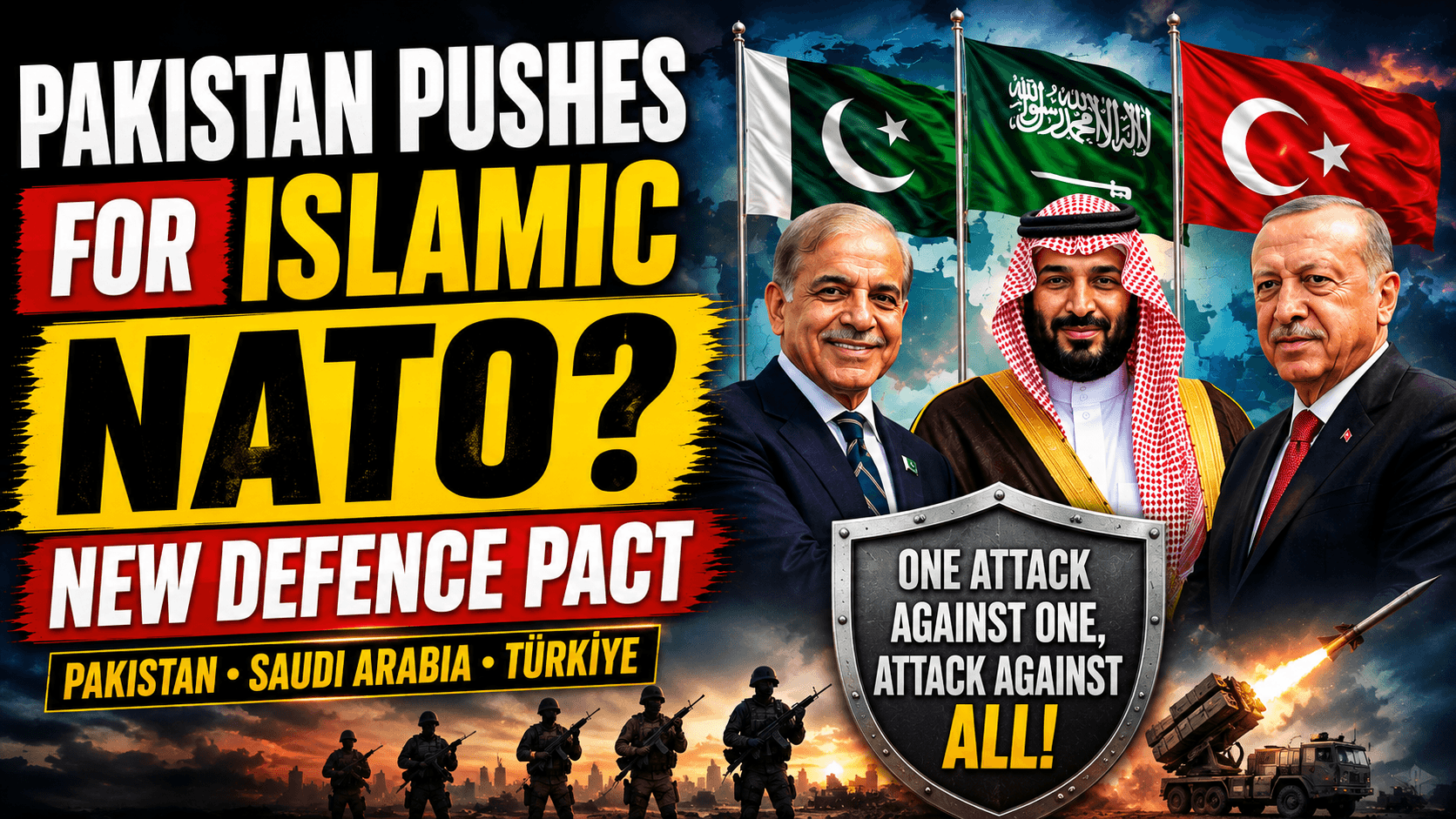
Pakistan Pushes for Broader 'Islamic NATO' Defence
Pakistan has renewed calls for broader defence cooperation among Muslim-majority countries following the signing of a landmark joint defence agreement with Saudi Arabia and Türkiye.
Siddhaanth Raghav
Pakistan Pushes for Broader 'Islamic NATO' Defence Framework After Pact With Saudi Arabia and Türkiye
New Mecca Defence Agreement Raises Possibility of Wider Security Cooperation Among Muslim-Majority Countries
Pakistan has renewed calls for broader defence cooperation among Muslim-majority countries following the signing of a landmark joint defence agreement with Saudi Arabia and Türkiye.
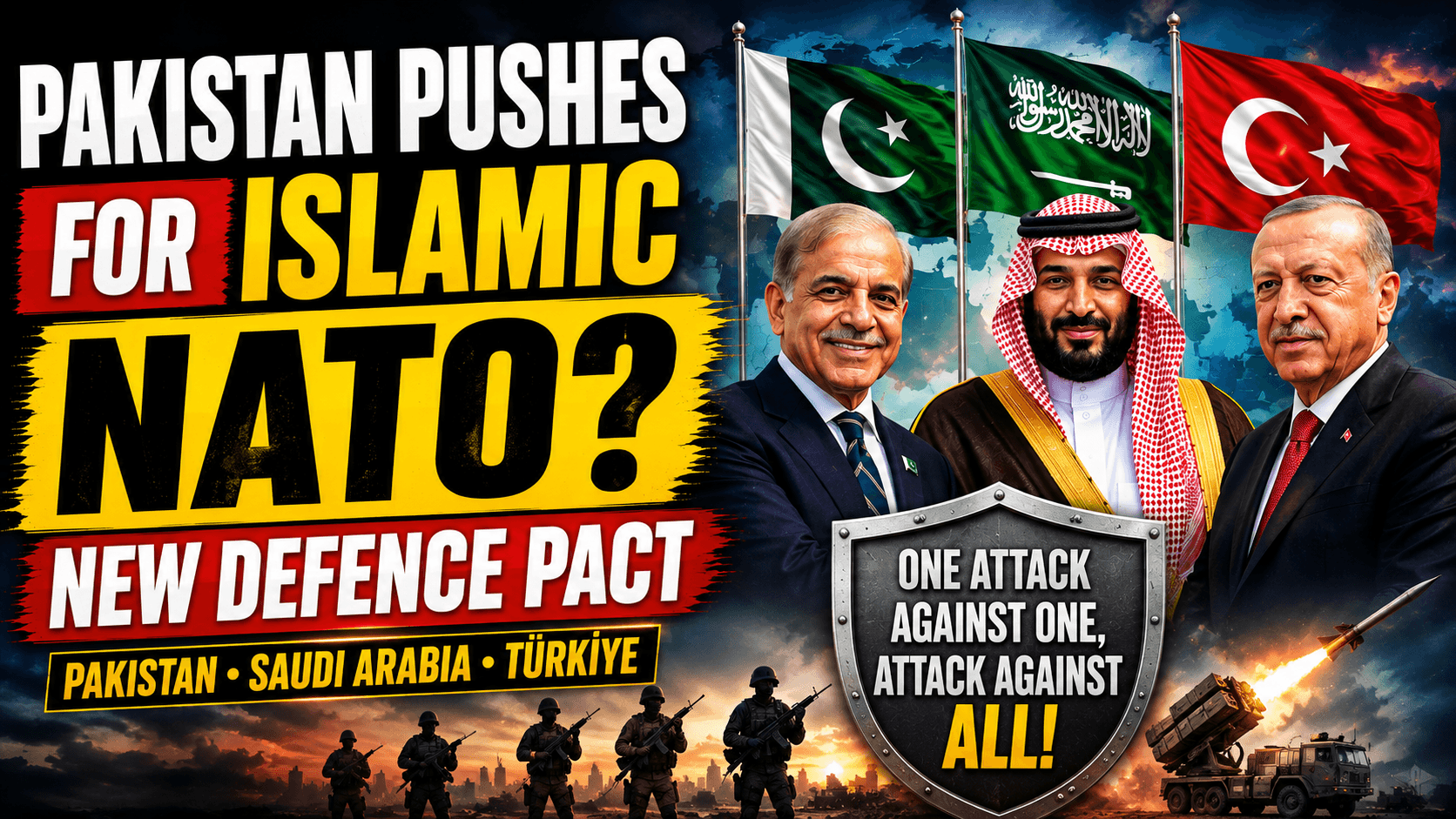
The agreement, signed in Mecca on August 7, 2026, establishes a mutual-defence framework under which an armed attack against one of the three participating countries will be regarded as an attack against all three. The pact has prompted comparisons with NATO's collective-security principle, although it is not formally an "Islamic NATO."
The development comes amid heightened security tensions across the Middle East and growing discussions about how regional countries can strengthen their own defence capabilities and strategic coordination.
What Is the New Defence Agreement?
The Mecca Joint Defence Agreement** brings together Pakistan, Saudi Arabia and Türkiye in a new security framework.
Its central principle is collective defence: an armed attack against one member is considered an attack against all three.
The arrangement builds on existing bilateral security cooperation between Pakistan and Saudi Arabia while adding Türkiye as a major military partner.
The agreement also provides a framework for increased defence coordination among the three countries.
Why Is It Being Compared With NATO?
The comparison with NATO comes primarily from the pact's mutual-defence principle.
NATO's Article 5 establishes that an armed attack against one member is considered an attack against all members. The new Pakistan-Saudi-Türkiye agreement follows a broadly similar collective-security concept.
However, the two organizations are not identical.
NATO is a long-established multinational military alliance with extensive institutional structures, integrated commands and decades of joint planning. The new three-country agreement is much more limited and remains at an early stage of development.
The term **"Islamic NATO"** therefore describes a possible future direction rather than an officially established organization.
Pakistan's Broader Proposal
Pakistan has previously advocated greater collective security cooperation among Muslim-majority nations.
Following the trilateral agreement, attention has returned to the possibility of inviting additional countries into a wider defence framework.
Such an expansion could potentially involve other states with significant military, economic or strategic influence. However, there is currently no finalized list of additional members or a fully established multilateral organization comparable to NATO.
Pakistan's proposal therefore remains a developing diplomatic initiative rather than a completed alliance.
Why Saudi Arabia Matters
Saudi Arabia brings significant economic and strategic influence to the partnership.
Riyadh has been pursuing a major modernization of its armed forces while also seeking stronger regional security arrangements.
Its participation gives the new framework an important position in Gulf security discussions.
Saudi Arabia also maintains extensive relationships with Western countries, meaning the new agreement does not necessarily represent an immediate break from existing international partnerships.
Türkiye's Strategic Role
Türkiye adds another important dimension because of its substantial defence-industrial capabilities and its existing membership in NATO.
The country's military industry has developed significant capabilities in areas including unmanned systems, naval platforms and other defence technologies.
Türkiye's participation therefore gives the new framework additional military and technological depth.
At the same time, Türkiye remaining a NATO member demonstrates that participation in the new agreement does not automatically require abandoning existing security alliances.
Pakistan's Role
Pakistan is the only nuclear-armed country among the three participants.
Its armed forces have extensive experience in regional security operations, while Islamabad maintains longstanding defence relationships with both Saudi Arabia and Türkiye.
The agreement therefore brings together three countries with different but complementary strategic strengths.
Supporters argue that closer cooperation could improve military coordination and regional deterrence.
Regional Security Implications
The agreement comes at a time of significant instability across the Middle East.
Recent conflicts and tensions have increased concerns among regional governments about missile attacks, military escalation, terrorism and the protection of critical infrastructure.
The new framework could encourage greater cooperation in areas such as:
* Defence planning.
* Military training.
* Intelligence cooperation.
* Counterterrorism.
* Defence technology.
* Strategic coordination.
However, the precise mechanisms for implementing these areas will depend on future discussions among the three governments.
What About Other Muslim-Majority Countries?
One of the biggest questions is whether additional countries could eventually join.
A larger alliance would potentially have greater military, economic and diplomatic weight, but expansion would also be complicated.
Muslim-majority countries have different foreign-policy priorities, security concerns and relationships with major global powers. Differences between regional governments could make it difficult to establish a unified defence policy.
For that reason, transforming the current three-country agreement into a much larger alliance would likely require extensive negotiations.
Implications for India
The development is also being closely watched in South Asia.
Pakistan's participation in a collective-defence framework involving Türkiye and Saudi Arabia could have implications for India's strategic calculations, particularly because Pakistan and India have a long history of military tensions.
However, the agreement's actual impact on India will depend on how its collective-defence provisions are interpreted and implemented.
It would be premature to assume that the pact automatically changes the military balance in South Asia.
US and NATO Dimension
Türkiye's participation is particularly notable because the country is a member of NATO.
The new agreement therefore exists alongside Türkiye's established commitments within the Western alliance.
Rather than automatically creating a competing military bloc, the arrangement could become another layer of Türkiye's international security relationships.
The development nevertheless demonstrates the increasingly complex network of defence partnerships emerging across the Middle East and surrounding regions.
Challenges Ahead
Creating a broader collective-defence framework would face several challenges.
Countries considering participation would have to determine how mutual-defence commitments would operate, how military coordination would be organized and how disagreements between members would be handled.
Questions would also arise over funding, command structures, intelligence sharing and the circumstances under which members would be expected to provide military assistance.
These issues would become increasingly complicated as the number of participating countries grows.
What Happens Next?
For now, the focus will remain on implementing the trilateral agreement between Pakistan, Saudi Arabia and Türkiye.
The three governments are expected to develop mechanisms for deeper defence cooperation while assessing whether the framework can eventually be expanded.
Any decision to invite additional countries would represent a major diplomatic development and could significantly reshape regional security cooperation.
Conclusion
Pakistan's push for broader defence cooperation among Muslim-majority countries has gained renewed attention following the **Mecca Joint Defence Agreement** signed by Pakistan, Saudi Arabia and Türkiye.
The pact's principle that an armed attack against one member will be regarded as an attack against all three has led to comparisons with NATO's collective-security model. However, describing it as an **"Islamic NATO"** remains a political and media shorthand rather than the formal structure of an established alliance.
Whether the three-country framework develops into a larger regional security organization will depend on future negotiations, the willingness of additional countries to participate and the ability of the members to overcome their differing strategic interests.
Get More News on Swaggbuzz