
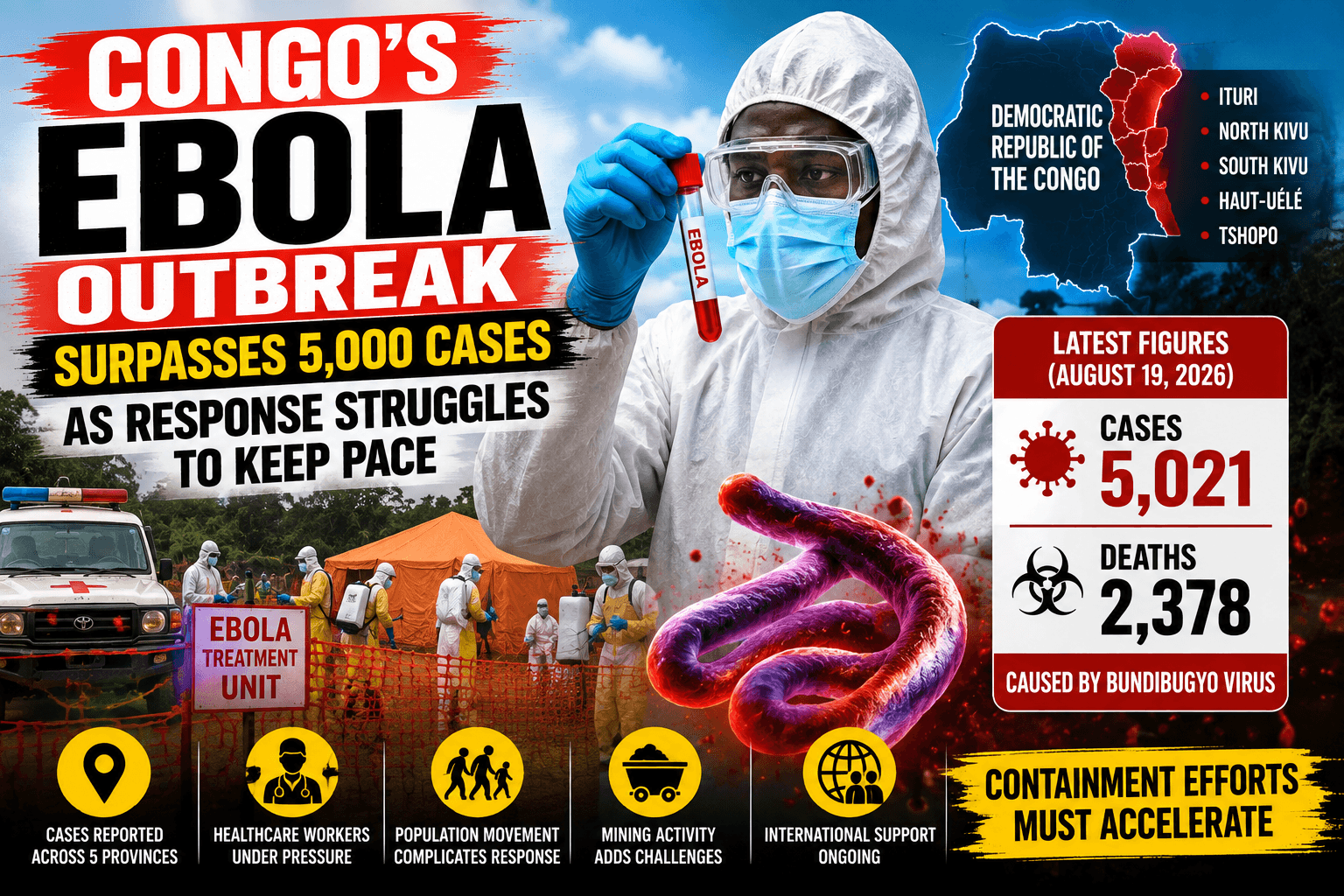
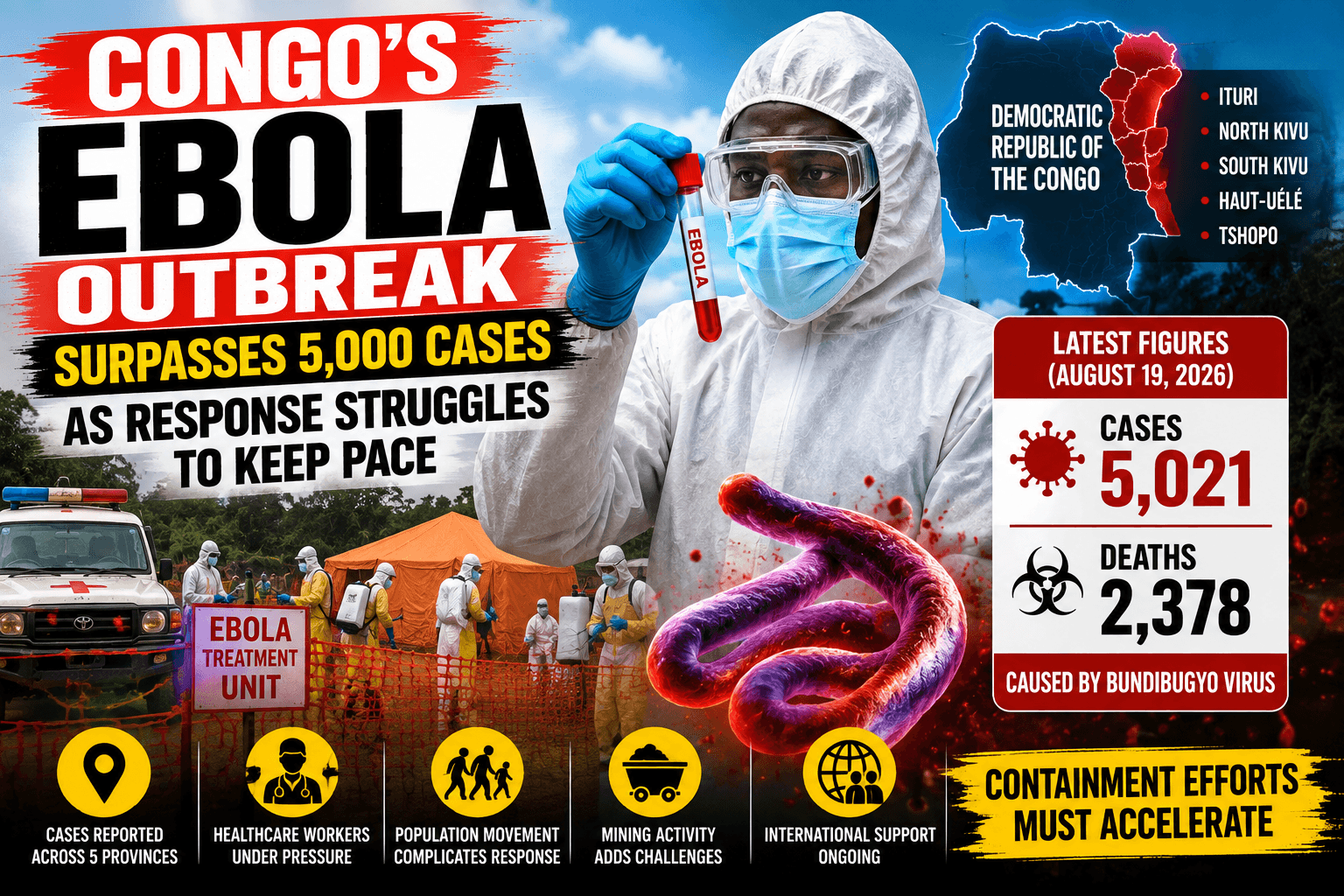
Congo's Ebola Outbreak Surpasses 5,000 Cases as Response Struggles to Keep Pace
Kinshasa, August 19, 2026 The Democratic Republic of the Congo is facing its largest Ebola outbreak on record, with the number of reported cases reaching 5,021 and deaths rising to 2,378, according to figures from Congo's Ministry of Health reported on August 19.
The outbreak, caused by the Bundibugyo virus, has expanded rapidly across parts of the country, placing enormous pressure on an already strained healthcare system. The World Health Organization has warned that continued transmission, population movement, insecurity and limited access to healthcare are making containment increasingly difficult.
Outbreak Has Become Congo's Largest
The current outbreak was declared in May 2026 after cases were identified in Ituri Province. It has since spread across multiple provinces, including Ituri, North Kivu, South Kivu, Haut-Uélé and Tshopo.
WHO previously reported that the outbreak had already surpassed Congo's previous largest Ebola outbreak, which occurred between 2018 and 2020 and recorded 3,317 confirmed cases. The latest figures now place the 2026 outbreak among the most serious Ebola epidemics ever recorded.
The speed of transmission has become a major concern for health authorities. The outbreak is reportedly progressing faster than the response systems can consistently detect and trace new infections, increasing the risk that cases will go unidentified before they can be isolated and treated.
Healthcare Workers Under Severe Pressure
Medical teams working in affected areas are struggling with limited resources, difficult working conditions and insecurity.
Recent reporting from affected communities has described exhausted healthcare workers attempting to keep pace with a growing number of patients while contact-tracing systems face significant pressure. In some areas, a large proportion of newly identified infections have been discovered outside previously monitored contacts, making traditional surveillance methods more difficult to maintain.
Healthcare workers have also faced disruptions caused by unpaid wages, shortages of personnel and attacks affecting medical facilities and response teams.
These conditions can delay the identification of new cases and make it harder for health authorities to establish chains of transmission.
Conflict and Population Movement Complicate Response
The outbreak is unfolding in parts of eastern Congo that have experienced years of insecurity and displacement.
People moving between communities, internally displaced populations and cross-border travel are making surveillance and contact tracing more complicated. WHO has warned that insecurity and attacks affecting healthcare facilities can restrict the ability of response teams to reach affected communities.
The situation is particularly challenging in Ituri Province, which has recorded the majority of cases. Mobile populations, including people working in informal mining areas, can also make it difficult for health authorities to maintain consistent monitoring.
Mining Activity Adds Another Challenge
Artisanal gold mining has become an additional concern in some affected areas.
Mining communities can involve large numbers of highly mobile workers who frequently travel between locations. Health workers have warned that limited sanitation facilities and difficulty reaching mobile populations can complicate efforts to identify potential infections and prevent further transmission.
The combination of mining activity, displacement and insecurity creates a particularly difficult environment for disease-control teams.
Bundibugyo Virus Creates Additional Difficulties
The outbreak is being caused by the Bundibugyo virus, a species of Ebola for which there is currently no approved vaccine or specific treatment.
WHO says supportive medical care remains important, while researchers and health authorities continue working on potential medical countermeasures. The lack of an approved vaccine or specific therapy for this particular Ebola species makes early detection, infection prevention and supportive treatment especially important.
The outbreak was declared a public health emergency of international concern by the WHO Director-General in May after cases were detected in the Democratic Republic of the Congo and Uganda.
International Response Continues
The WHO and other international partners are supporting Congo's health authorities with surveillance, laboratory testing, contact tracing, infection prevention and clinical preparedness.
However, officials say a substantial expansion of response activities is needed to get ahead of the outbreak. WHO has emphasized that cooperation with affected communities is essential because mistrust, misinformation and insecurity can undermine disease-control measures.
Uganda, which recorded cases linked to the outbreak in Congo, declared its own Bundibugyo outbreak over in July after going through the required period without a new locally transmitted case. However, WHO continues to regard Uganda as vulnerable to imported cases because transmission remains active in neighboring Congo.
Congo Faces a Critical Test
The rapid rise in cases has turned the outbreak into one of the country's most serious public-health emergencies in recent years.
Containing the epidemic will depend on the ability of authorities and international partners to expand surveillance, reach remote communities, protect healthcare workers and maintain access to treatment despite insecurity and population movement.
The latest figures underline the scale of the challenge facing Congo. With more than 5,000 reported cases and thousands of deaths, health authorities are under increasing pressure to accelerate containment efforts before the outbreak spreads further.
Get More News on Swaggbuzz
Author
About the author
Siddhaanth Raghav
Topics