
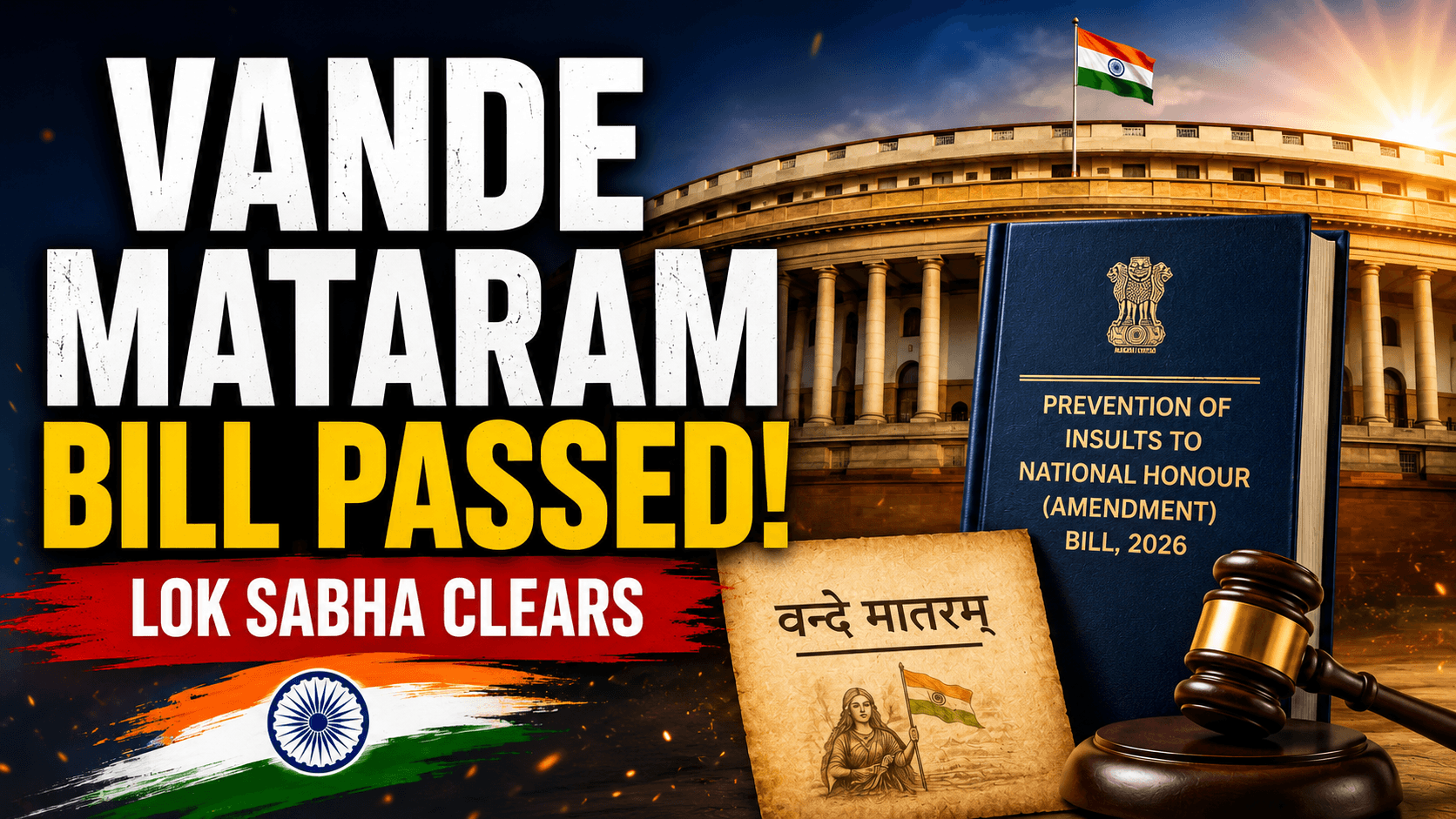
Lok Sabha Clears Landmark Legislation Granting National Song
India's Parliament has passed the Prevention of Insults to National Honour (Amendment) Bill, 2026, popularly known as the Vande Mataram Bill, after it was approved by the Lok Sabha, a day following its passage in the Rajya Sabha.
Siddhaanth Raghav
Vande Mataram Bill Passed by Parliament: Lok Sabha Clears Landmark Legislation Granting National Song Equal Legal Protection
Parliament Approves Amendment to Extend the Same Legal Protection to 'Vande Mataram' as the National Anthem and National Flag
India's Parliament has passed the **Prevention of Insults to National Honour (Amendment) Bill, 2026, popularly known as the Vande Mataram Bill, after it was approved by the Lok Sabha, a day following its passage in the Rajya Sabha. The legislation marks a significant development in India's legal framework governing national symbols and seeks to provide the country's national song, "Vande Mataram," with the same legal protection currently enjoyed by the National Anthem and the National Flag.
With both Houses of Parliament approving the bill, it will now be sent to the **President of India** for assent. Once it receives presidential approval, the amendment will officially become law.
The passage of the bill concluded one of the most closely watched debates during the **Monsoon Session of Parliament 2026**, drawing support from the ruling alliance while prompting criticism and protests from several opposition parties.
What Is the Vande Mataram Bill?
The bill is an amendment to the Prevention of Insults to National Honour Act, expanding the law to include "Vande Mataram" under the same legal protections that already apply to the National Anthem and the National Flag.
According to the government, the amendment is intended to ensure that deliberate acts of disrespect or insult directed at the national song are treated with the same seriousness as offenses involving other officially protected national symbols.
The legislation does not alter the constitutional status of "Vande Mataram." Instead, it focuses on extending legal safeguards against intentional acts of disrespect.
Lok Sabha Passes the Bill After Rajya Sabha Approval
The legislation was cleared by the Lok Sabha after receiving approval in the Rajya Sabha a day earlier.
Its passage through both Houses completes the parliamentary process, leaving only the President's assent before the amendment becomes law.
The debate in Parliament saw members of the ruling coalition describe the bill as an important step toward honoring India's national heritage, while several opposition members questioned both the timing of the legislation and broader issues raised during the Monsoon Session.
Government's Stand
The Union Government defended the amendment by emphasizing the historical importance of **"Vande Mataram"** during India's freedom struggle.
Ministers argued that the national song inspired generations of freedom fighters and has long occupied a unique place in India's cultural and political history.
According to the government, extending equal legal protection reflects the significance of the song while promoting respect for national symbols.
Officials also maintained that the amendment is intended solely to strengthen legal safeguards against deliberate acts of insult and should not be viewed as altering existing constitutional provisions.
Opposition Response
The legislation sparked strong political debate during its consideration in Parliament.
Several opposition parties expressed concerns over the bill and staged protests during the Monsoon Session, arguing that Parliament should also devote greater attention to pressing economic, social, and governance-related issues.
Some opposition members questioned the necessity of introducing the amendment at this stage, while others sought broader discussions before the bill was taken up for voting.
Despite these objections, the bill secured parliamentary approval.

Historical Significance of 'Vande Mataram'
"Vande Mataram" holds a prominent place in India's history.
Written by Bankim Chandra Chattopadhyay in the late nineteenth century as part of the novel Anandamath, the song became one of the most influential patriotic expressions during the Indian independence movement.
It inspired countless freedom fighters and played an important role in mobilizing nationalist sentiment during British colonial rule.
Following Independence, "Vande Mataram" was accorded the status of India's National Song, while "Jana Gana Mana" was adopted as the National Anthem.
The newly passed amendment seeks to recognize this historical importance through enhanced legal protection.
What the Amendment Means
Once enacted, the amendment will extend legal safeguards to "Vande Mataram" under the Prevention of Insults to National Honour Act.
The legislation is intended to address deliberate acts of insult or disrespect toward the national song in a manner similar to existing protections for the National Anthem and the National Flag.
Legal experts note that the precise implementation of the amended law will depend on its final notified provisions after receiving Presidential assent.
Political and Constitutional Significance
The passage of the Vande Mataram Bill has attracted nationwide attention because it concerns one of India's most recognizable national symbols.
Supporters view the legislation as a measure to reinforce national respect and preserve India's historical heritage.
Critics, however, have emphasized the importance of balancing legal protections with constitutional rights and ensuring that implementation remains consistent with established legal principles.
As with many major legislative measures, legal interpretation may continue to evolve after the amendment comes into force.
What Happens Next?
The bill has now completed the parliamentary approval process.
The next step is **Presidential assent**, after which the amendment will be officially notified and become part of Indian law.
Government agencies are expected to issue any necessary implementation guidelines following notification.
The legislation is also likely to remain a subject of public discussion among legal experts, historians, political leaders, and constitutional scholars.
Conclusion
The passage of the Vande Mataram Bill by both Houses of Parliament marks a significant legislative development during the Monsoon Session of 2026. By extending the same legal protection to India's national song as that provided to the National Anthem and National Flag, the government says the amendment recognizes the historical and national significance of "Vande Mataram."
While the bill has generated political debate, its parliamentary approval represents an important milestone in India's evolving legal framework relating to national symbols. The focus now shifts to the President's assent, after which the amendment is expected to become law and take effect across the country.
Get More News on Swaggbuzz