
Huge SpaceX Rocket Part Believed to Have Hit the Moon
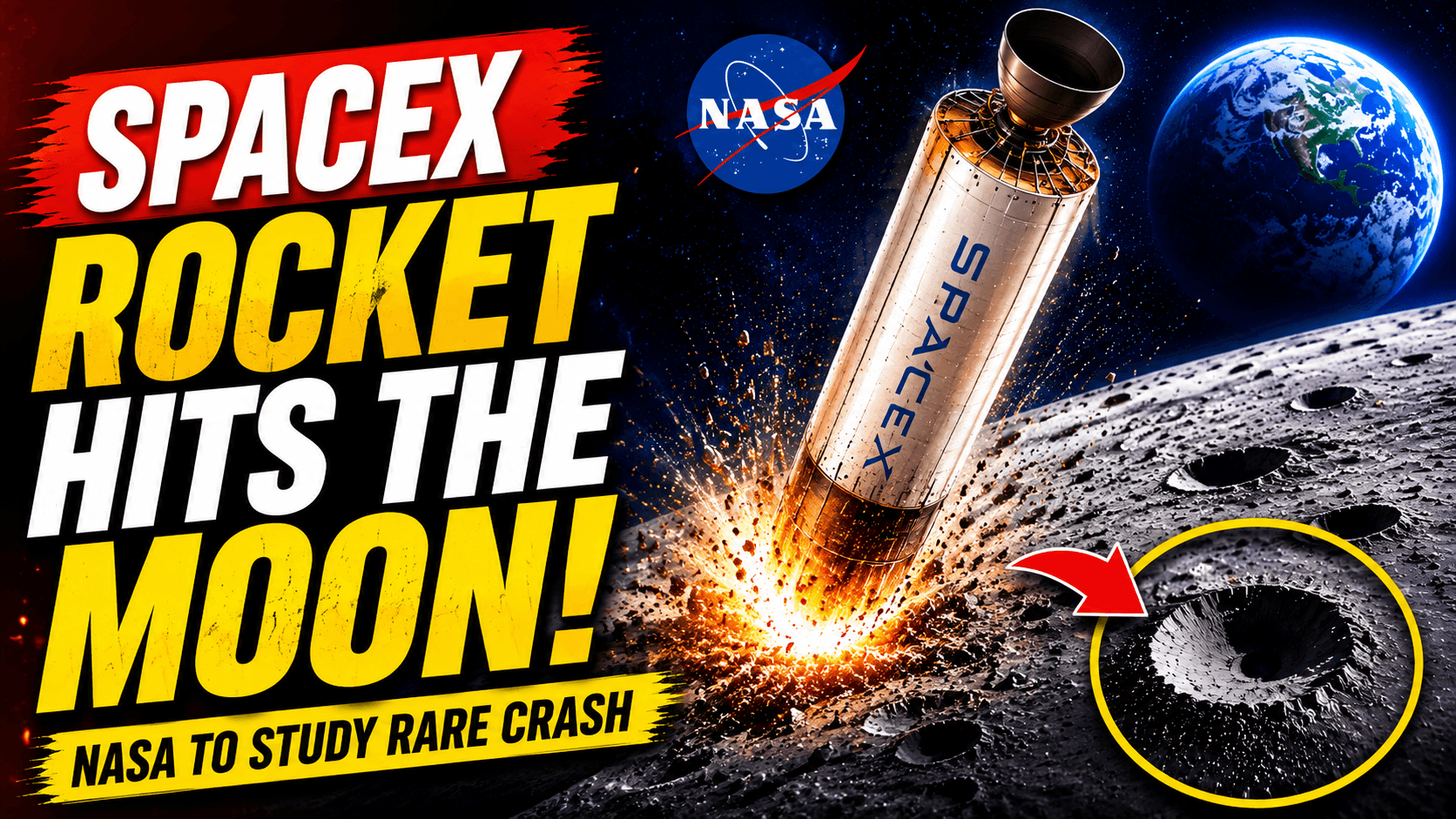
A discarded **SpaceX Falcon 9 upper-stage rocket** is believed to have crashed into the Moon after drifting through space for more than a year, creating what scientists expect to be a fresh impact crater on the lunar surface.
Siddhaanth Raghav
Huge SpaceX Rocket Part Believed to Have Hit the Moon as NASA Prepares to Study Rare Lunar Crash
Discarded Falcon 9 Rocket Stage Creates Unique Scientific Opportunity for Researchers Studying the Moon
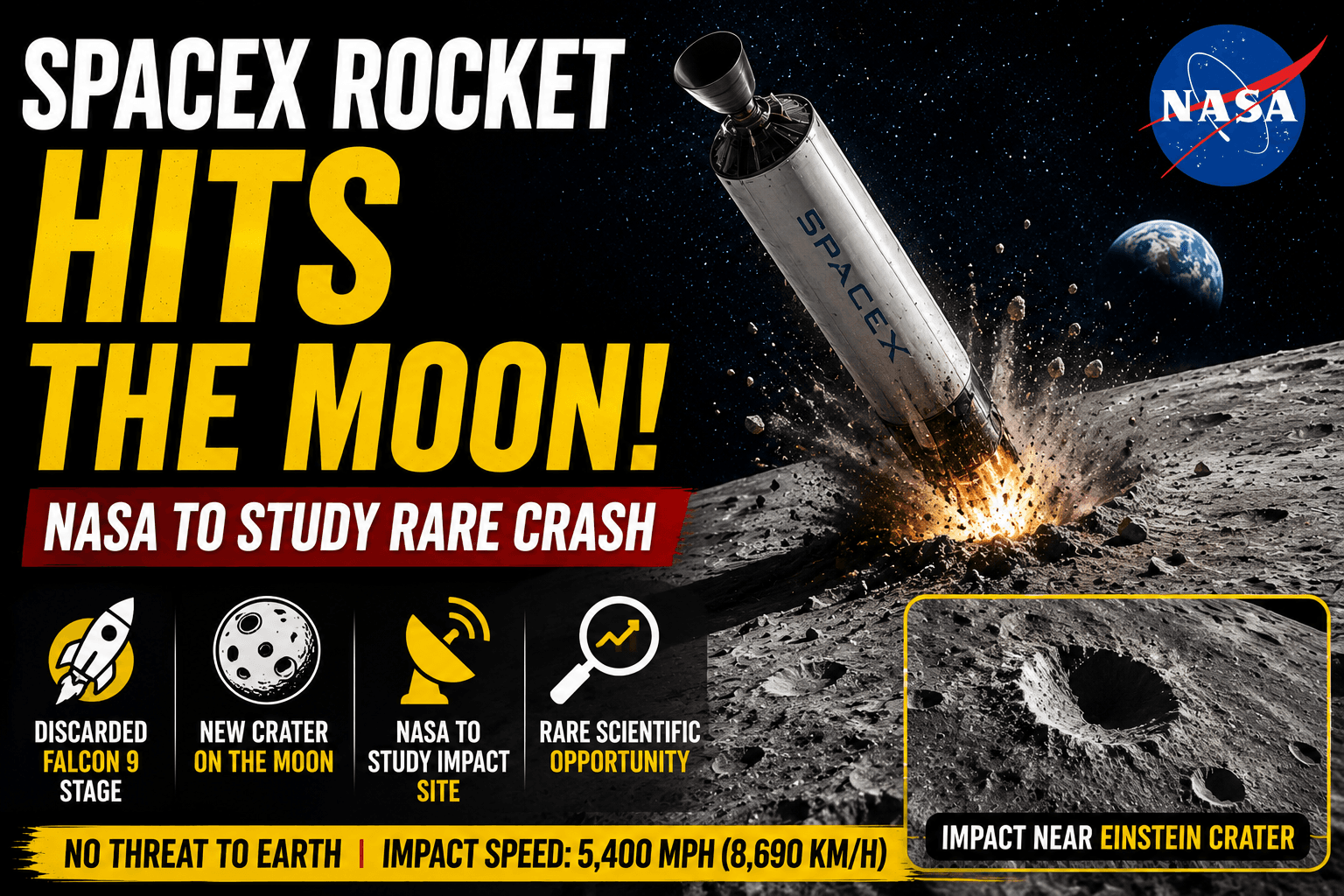
A discarded SpaceX Falcon 9 upper-stage rocket is believed to have crashed into the Moon after drifting through space for more than a year, creating what scientists expect to be a fresh impact crater on the lunar surface. The accidental collision has attracted worldwide attention, not because it poses any danger to Earth, but because it offers researchers a rare opportunity to study the effects of a known, human-made object striking the Moon.
According to scientists tracking the object, the rocket stage impacted the Moon at an estimated speed of **5,400 mph (8,690 km/h)** near the **Einstein Crater** on the Moon's far western limb. Because the impact occurred in a location that is difficult to observe directly from Earth, researchers will rely on data from lunar orbiters and telescopes to confirm the collision and analyze its effects.
What Was the Object?
The object is believed to be the **second stage of a SpaceX Falcon 9 rocket** that launched **Firefly Aerospace's Blue Ghost Mission 1** in January 2025.
After completing its mission, the upper stage did not have enough fuel to perform a controlled return to Earth's atmosphere. Instead, it remained in space, gradually drifting under the influence of the Sun's gravity and the gravitational pull of the Earth and Moon until its orbit intersected with the lunar surface.
Unlike the reusable first stage of the Falcon 9, upper stages used for deep-space missions often cannot safely return to Earth because of the enormous distances involved.
High-Speed Impact on the Moon
Scientists estimate that the rocket struck the Moon at approximately **8,690 km/h (5,400 mph)**.
Although the impact released energy comparable to several tonnes of TNT, it posed no risk to Earth or future lunar missions in the immediate area.
Researchers expect the collision to have produced a new crater measuring roughly **12 to 18 metres (40 to 60 feet)** across, along with a plume of lunar dust and debris.
The exact size and appearance of the crater will be confirmed only after high-resolution orbital imagery becomes available.
Why NASA Is Interested
For planetary scientists, the unexpected collision represents a valuable scientific opportunity.
Because the object's size, speed, mass, and approximate impact location are already known, researchers can compare computer models with actual observations to better understand how impacts shape the lunar surface.
NASA and international research teams are expected to study:
- The size and depth of the new crater.
- The amount of dust ejected by the impact.
- How lunar soil responds to high-speed collisions.
- The composition of material exposed beneath the Moon's surface.
- The long-term effects of impacts on future lunar infrastructure.
These findings may contribute to planning future human and robotic missions under NASA's Artemis program and other international lunar exploration projects.
No Threat to Earth
Scientists have emphasized that the impact presented no danger to Earth.
Unlike satellites orbiting Earth, the rocket stage had escaped Earth's gravitational influence and was traveling in cislunar space before eventually colliding with the Moon.
Astronomers note that impacts of natural meteoroids occur on the Moon regularly. What makes this event unusual is that the impacting object is a well-identified piece of human-made space hardware.
Growing Challenge of Space Debris
The incident has renewed discussions about the management of space debris beyond Earth's orbit.
As more countries and private companies launch missions to the Moon, Mars, and other destinations, experts say improved tracking and disposal strategies will become increasingly important.
Space agencies are exploring ways to:
- Safely dispose of upper rocket stages.Reduce long-term space debris.
- Improve tracking of deep-space objects.
- Minimize accidental impacts on celestial bodies.
- Support sustainable lunar exploration.
The event illustrates that responsible mission planning extends beyond Earth orbit as human activity in space continues to expand.
A Rare Scientific Experiment
Unlike intentional impact missions conducted by NASA in the past to study planetary surfaces, this collision was unplanned.
Even so, scientists say it provides a controlled scientific scenario because researchers know the approximate characteristics of the impacting object.
By comparing before-and-after images from lunar orbiters, researchers hope to learn more about impact mechanics and the Moon's geological history.
The event may also help improve computer models used to predict the effects of future asteroid or spacecraft impacts.
Future Lunar Missions
The Moon is expected to become increasingly active over the coming decade as governments and private companies expand exploration progr
NASA's Artemis initiative, commercial lunar landers, scientific orbiters, and future international missions will all contribute to a growing human presence around the Moon.
Understanding how accidental impacts affect the lunar environment will become increasingly important as permanent infrastructure and scientific equipment are placed on the lunar surface.
Looking Ahead
Scientists now await detailed images from orbiting spacecraft to verify the impact site and measure the newly formed crater.
Observations collected over the coming weeks and months are expected to improve understanding of both lunar geology and the behavior of human-made objects in deep space.
Researchers also believe the incident will encourage renewed discussions about international standards for disposing of spacecraft components after missions are completed.
Conclusion
The suspected collision of a discarded SpaceX Falcon 9 upper stage with the Moon marks an unusual event in the history of space exploration. While the impact poses no threat to Earth, it provides scientists with a rare opportunity to study a known object striking the lunar surface under well-understood conditions.
As NASA and other research organizations analyze the aftermath, the event is expected to contribute valuable insights into lunar science, impact physics, and the growing importance of responsible space debris management. With lunar exploration accelerating around the world, lessons learned from this unexpected collision could help shape the future of sustainable space exploration.
Get More News on Swaggbuzz