
Jio Platforms Enters Global Top 5 Telecom Companies With $137.3 Billion Valuation
Mumbai, October 29, 2026: Jio Platforms, the telecommunications and digital-services arm of Reliance Industries, has achieved a major milestone by entering the world's five most valuable telecom companies by market capitalisation. Following its stock-market debut on October 28, the company reached a market valuation of approximately $137.3 billion, or ₹13.1 lakh crore, according to Bloomberg data cited by *The Economic Times*.
The achievement places Jio Platforms ahead of Germany's Deutsche Telekom and strengthens India's position in the global telecommunications industry. The company's valuation reflects investor expectations surrounding its 4G and 5G networks, digital platforms and potential expansion into emerging technology businesses.
However, Jio's entry into the global top five also raises questions about its premium valuation compared with established international telecom operators. Its future performance will depend on its ability to convert its market position and digital capabilities into sustainable business growth.
Jio Platforms Enters the Global Top Five
Jio Platforms' stock-market debut has reshaped the global telecommunications market-capitalisation rankings. With a reported valuation of $137.3 billion, the company secured fifth place among the world's most valuable telecom operators.
The milestone follows years of expansion in India's telecommunications market, where Jio has established a substantial customer base through affordable mobile connectivity, high-speed internet and digital services.
According to Bloomberg data reported by *The Economic Times*, Jio's valuation exceeded Deutsche Telekom's market capitalisation of approximately $135.5 billion. The relatively narrow difference between the two companies means their positions could change as share prices fluctuate.
Jio's achievement is particularly significant because it has developed its business around modern 4G and 5G infrastructure, while several international competitors operate established telecommunications businesses with extensive legacy networks.
The ranking reflects market capitalisation rather than subscriber numbers, revenue or profitability. It therefore measures the market's valuation of a company rather than providing a complete assessment of its operational scale.
World's Five Most Valuable Telecom Companies
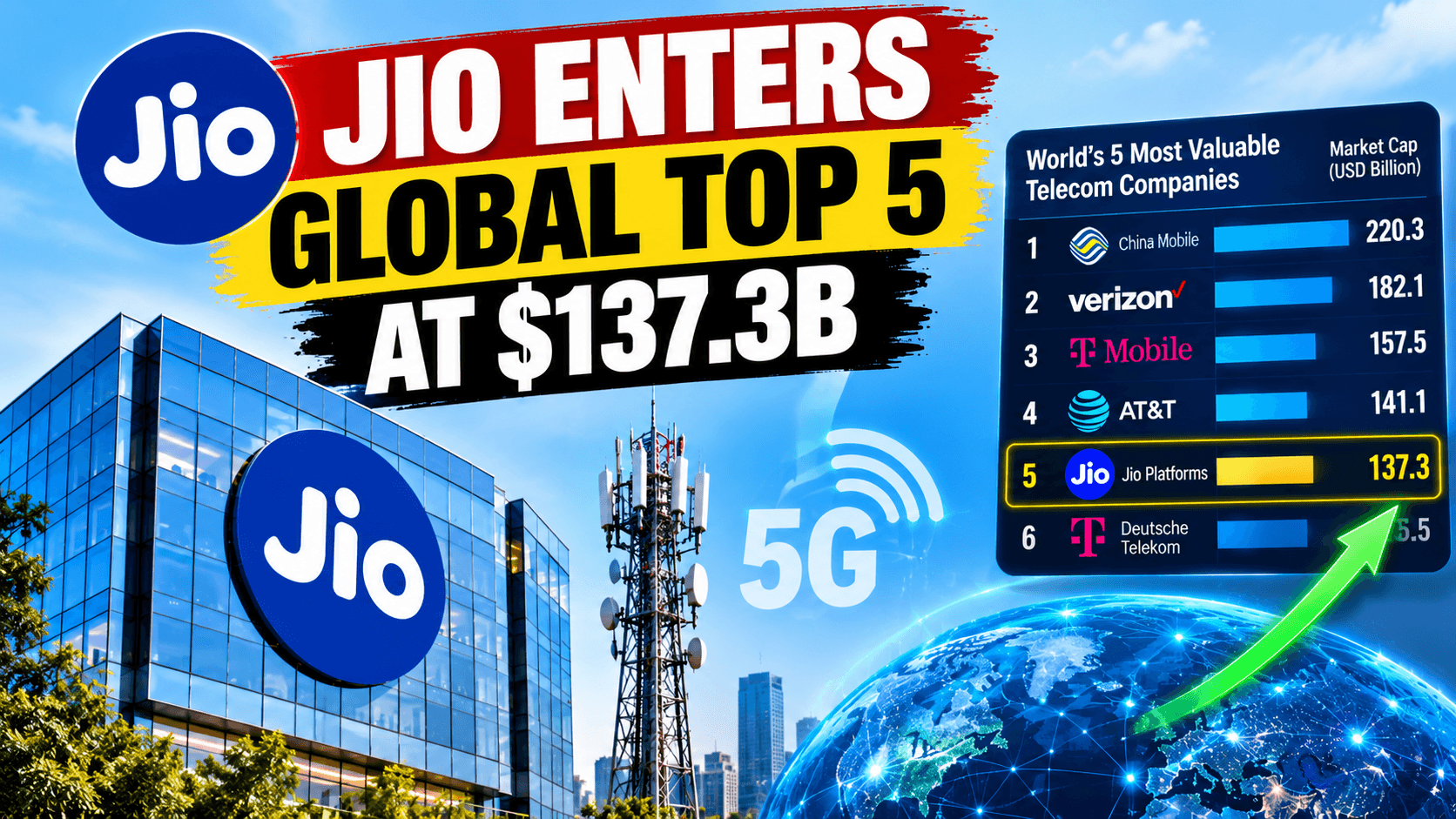
Bloomberg data cited in the October 29 report placed the following companies at the top of the global telecommunications market-capitalisation rankings:
Rank | Telecom company | Market capitalisation
1 China Mobile | $220.3 billion
2 Verizon | $182.1 billion
3 T-Mobile US | $157.5 billion
4 AT&T | $141.1 billion
5 Jio Platforms | $137.3 billion
6 Deutsche Telekom | $135.5 billion
Source: Bloomberg data reported by The Economic Times on October 29, 2026. Market capitalisations fluctuate with share prices and currency movements.
China Mobile leads the rankings, followed by the US-based operators Verizon and T-Mobile US. AT&T occupies fourth place, while Jio Platforms has entered the fifth position.
The figures put Jio close to AT&T and Deutsche Telekom in market value, demonstrating how quickly its valuation has placed it among major global telecommunications businesses.
What Is Driving Jio Platforms' Valuation?
Jio's valuation is closely linked to its telecommunications infrastructure and broader digital-services strategy.
Unlike operators whose businesses primarily focus on traditional connectivity, Jio has developed an ecosystem that combines mobile services, broadband connectivity and digital platforms. Its investments in modern network infrastructure have helped position it to serve India's growing demand for data-intensive services.
Several factors contribute to investor interest in the company.
1. Expansion of 4G and 5G Networks
Jio has invested heavily in network infrastructure to support mobile broadband, high-speed data and the expansion of 5G services.
As demand for digital connectivity increases, telecom operators can benefit from opportunities in consumer services, enterprise connectivity and connected devices. Jio's network investments provide a foundation for pursuing these opportunities.
2. A Large Indian Digital Market
India's expanding digital economy provides opportunities for telecommunications companies to develop services beyond traditional voice and data connections.
Businesses and consumers increasingly depend on digital platforms for communication, entertainment, payments and online services. Jio's existing customer relationships give it a potential advantage when introducing additional products and services.
However, converting this market opportunity into higher revenue and profits will depend on customer demand, pricing, competition and execution.
3. Digital Platforms and Technology Investments
Jio's strategy extends beyond telecommunications infrastructure to include digital services and technology platforms.
The company has opportunities to expand its presence in enterprise solutions, cloud services and artificial intelligence-related applications. These areas could provide additional revenue sources if Jio can develop commercially successful offerings.
Nevertheless, the scale of these opportunities should not be confused with guaranteed future earnings. Investors will need to assess actual business performance as these initiatives develop.
Jio's Valuation Compared With Global Rivals
Although Jio has entered the global top five by market capitalisation, its valuation relative to earnings is considerably higher than that of several established international telecom operators.
According to *The Economic Times*, Jio's price-to-earnings ratio, calculated using its market capitalisation at the time and its FY2026 net profit, stood at approximately 43.5.
By comparison, the report placed the price-to-earnings ratios of major global telecom operators in a range of approximately eight to fourteen. Bharti Airtel, Jio's closest Indian competitor, was reported to have a multiple of around 45.6.
A higher price-to-earnings ratio can indicate that investors expect stronger future growth. However, it can also mean that a company has less room for disappointment if its earnings fail to meet market expectations.
Jio's premium valuation therefore reflects expectations about its growth potential, but the company will need to deliver sustained financial performance to support that valuation over time.
What Jio's Stock-Market Debut Means for Reliance Industries
Jio Platforms' listing also has implications for its parent company, Reliance Industries.
Before the listing, Jio's business was housed within the larger Reliance group. Its separate market valuation now gives investors a more direct way to assess the telecommunications and digital-services business independently.
The stock-market debut also made Jio one of India's most valuable listed companies. Its market capitalisation placed it ahead of Bharti Airtel and behind Reliance Industries in the domestic corporate rankings reported after listing.
The listing provides greater visibility into Jio's valuation and could help investors distinguish its financial performance from Reliance Industries' other businesses.
However, a company's market capitalisation is not the same as cash generated by its operations. Its valuation changes with market prices, and the long-term benefits of a listing depend on business performance, investment decisions and shareholder returns.
Can Jio Maintain Its Position Among the World's Leading Telecom Operators?
Maintaining a place among the world's five most valuable telecom companies will depend on several factors, including earnings growth, subscriber activity, competition and the performance of its digital businesses.
Jio operates in a competitive Indian telecommunications market, where pricing, network quality and customer retention remain important. Continued investment in network infrastructure can support growth, but it also requires capital and efficient execution.
The company will also need to demonstrate that its digital platforms and technology investments can generate meaningful additional revenue rather than relying entirely on expectations of future expansion.
Meanwhile, global rankings can change quickly as share prices fluctuate. Jio's fifth-place position represents its reported market capitalisation at a particular point in time, not a permanent ranking.
Investors will therefore be watching subsequent financial results, operating performance and the company's ability to translate its technology investments into sustainable earnings.
Conclusion
Jio Platforms' entry into the global top five telecom companies marks an important milestone for India's telecommunications and digital-services industry. With a reported market capitalisation of $137.3 billion, the company moved ahead of Deutsche Telekom and joined a group dominated by major operators from China, the United States and Europe.
The achievement highlights the market's confidence in Jio's modern network infrastructure, established position in India and opportunities in digital services. Its separate stock-market listing has also made the business's valuation more visible to investors.
However, maintaining this position will require more than a strong market debut. Sustainable earnings growth, competitive network services and successful expansion into new digital businesses will be central to Jio's long-term performance.
For India's telecom sector, Jio's global ranking is a significant development. The next test will be whether the company can turn its premium valuation into lasting business growth.
Get More News on Swaggbuzz
Author
About the author
Siddhaanth Raghav
Topics