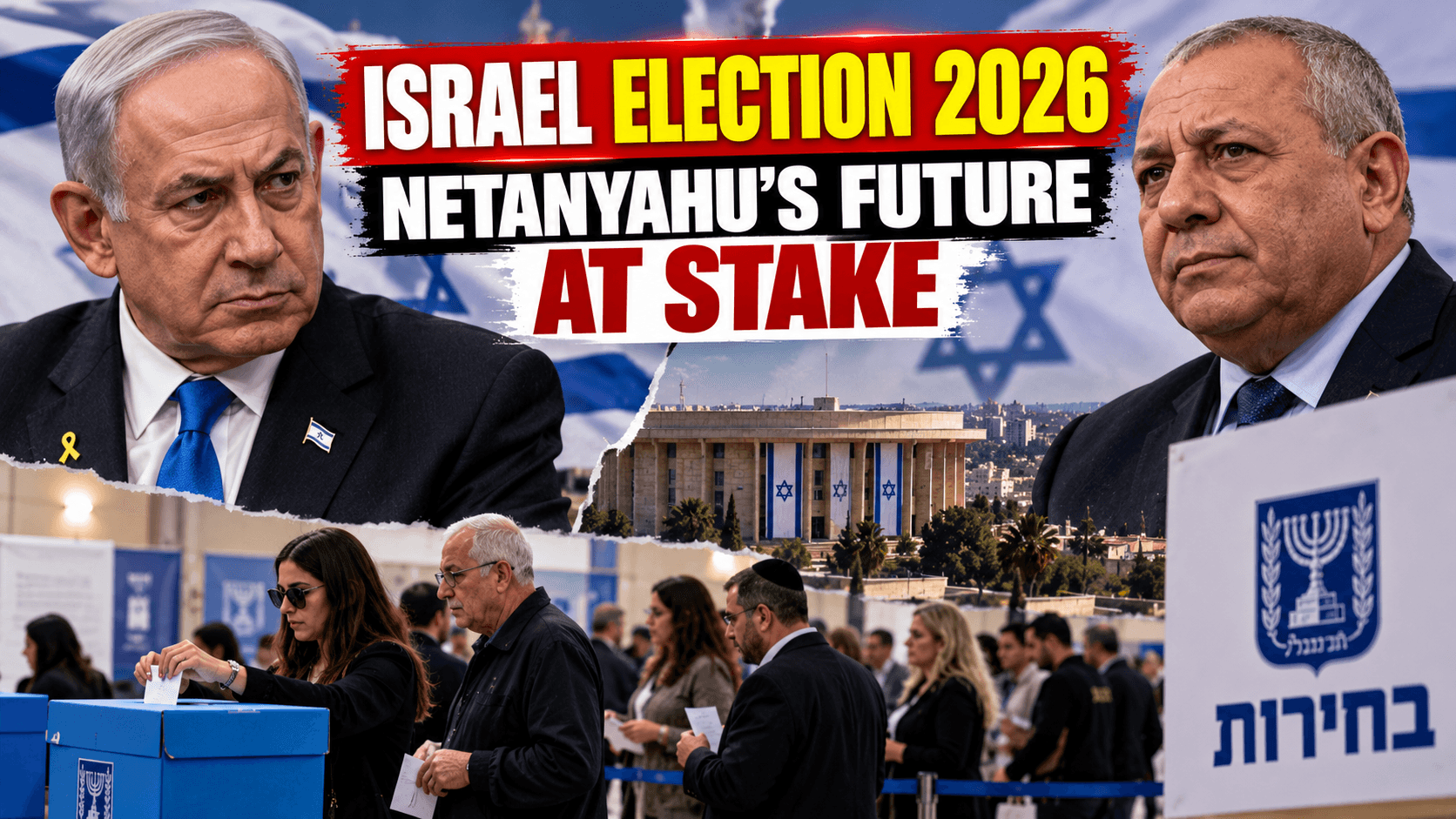

Israel Election 2026: Netanyahu's Political Future at Stake as Gadi Eisenkot Challenges His Leadership
Jerusalem, October 27, 2026: Israel has begun voting in a closely contested general election that could determine the political future of Prime Minister Benjamin Netanyahu after years of conflict, domestic political divisions and growing public debate over national security. Netanyahu faces a significant challenge from opposition contender Gadi Eisenkot, a former military chief whose campaign has focused on accountability for the security failures surrounding the October 7, 2023, Hamas-led attacks.
The election is Israel's first parliamentary vote since the attacks and the subsequent regional conflicts involving Gaza, Lebanon and Iran. With opinion polls suggesting that neither major political bloc is assured of a parliamentary majority, the result could lead to difficult coalition negotiations and potentially prolong the country's political uncertainty.
Netanyahu Faces a Defining Test of Political Leadership
Benjamin Netanyahu, Israel's longest-serving prime minister, is seeking to maintain his position amid intense scrutiny of his government's record. His leadership has been shaped by the October 7 attacks, military operations across the region, disagreements over security policy and mounting political divisions at home.
Netanyahu has presented his experience in national security and his relationship with US President Donald Trump as important advantages. His supporters argue that his leadership is essential to protecting Israel's security interests during a period of regional instability.
However, critics have questioned the government's preparedness for the October 7 attacks and demanded greater accountability for the failures that allowed the assault to occur. The subsequent wars and their consequences have also intensified debate over the government's strategic decisions.
The election therefore represents more than a contest between political parties. It is also a test of whether voters believe Netanyahu should continue leading the country or whether a change in leadership is necessary.
Gadi Eisenkot Emerges as a Major Opposition Challenger
Former Israel Defense Forces chief of staff Gadi Eisenkot has emerged as Netanyahu's principal challenger. Leading the centrist Yashar party, Eisenkot has attracted support from voters seeking a different approach to governance and greater accountability for the security failures of October 2023.
Eisenkot's military background gives him credibility among voters concerned about national security. However, his campaign also faces the challenge of uniting opposition parties with different political priorities.
His criticism of Netanyahu has focused on the government's handling of the October 7 security failures, its management of subsequent conflicts and its dependence on far-right coalition partners.
Despite his criticism of the government, Eisenkot is not advocating a two-state solution to the Israeli-Palestinian conflict. His political position combines a strong security outlook with criticism of some of the policies pursued by Netanyahu's right-wing allies.
The central question is whether Eisenkot can translate public dissatisfaction into sufficient parliamentary support to build an alternative government.
Election Polls Point to a Tight Parliamentary Contest
Pre-election surveys suggest that the race remains highly competitive, with neither Netanyahu's coalition nor the opposition bloc guaranteed the numbers needed to govern.
Israel's parliament, the Knesset, has 120 seats. A government needs the support of at least 61 lawmakers to secure a parliamentary majority.
The electoral system is based on proportional representation, meaning voters choose party lists rather than directly electing the prime minister. The distribution of seats among parties determines which political leader has the best chance of assembling a governing coalition.
Recent polling has placed Eisenkot's Yashar party and Netanyahu's Likud among the leading contenders. However, the number of seats won by each party is only part of the equation. The political affiliations of smaller parties and their willingness to cooperate after the election could determine the final outcome.
Consequently, even a party that finishes first may struggle to form a government if its potential partners cannot provide sufficient parliamentary support.

Coalition Shifts Could Decide Who Forms the Next Government
Coalition negotiations are expected to play a decisive role in determining Israel's next government. Netanyahu relies on support from right-wing, far-right and ultra-Orthodox parties, including groups led by Itamar Ben-Gvir and Bezalel Smotrich.
These alliances have helped Netanyahu maintain power, but they have also generated criticism over policies affecting Palestinians, the occupied West Bank and the future of Gaza.
Eisenkot's potential partners include parties led by former prime minister Naftali Bennett, opposition politician Avigdor Lieberman and Yair Golan. Although these parties share opposition to Netanyahu's continued leadership, they differ on several policy questions and their preferred approaches to government formation.
Arab-majority political parties could also influence the parliamentary balance. Their performance may prove particularly important if neither major bloc secures a majority independently. However, cooperation between Arab parties and mainstream Jewish opposition parties remains politically contentious
The result could produce a new coalition, a minority government, an agreement involving parties from different political camps or an extended deadlock. If no viable government emerges, Israel could face another election.
Gaza and Regional Security Remain Central Election Issues
Security remains a major concern for Israeli voters following the October 7 attacks and the conflicts that followed. The future of Gaza, relations with neighbouring countries and the continuing threat of regional escalation have all influenced the political debate.
Netanyahu has emphasised his government's military record and its efforts to defend Israel against regional adversaries. His supporters view a strong security posture as necessary to protect the country.
Opponents, meanwhile, have questioned whether the government's approach has delivered lasting security and whether its decisions have increased Israel's international isolation.
The humanitarian consequences of the war in Gaza have also drawn international attention. The conflict has caused extensive destruction and a severe humanitarian crisis, making the future of Gaza an important issue for regional diplomacy.
Although Eisenkot challenges Netanyahu's leadership, he also maintains a security-focused approach and opposes Hamas continuing to govern Gaza. The election is therefore unlikely to produce a simple choice between security and diplomacy; instead, voters are weighing competing approaches to national security, political accountability and regional stability.
Voter Turnout and Smaller Parties Could Prove Decisive
Beyond the contest between Netanyahu and Eisenkot, voter turnout and the performance of smaller parties could significantly influence the result.
Arab citizens account for a substantial minority of Israel's population, and turnout within this community could affect the balance of parliamentary seats. Political leaders in Arab communities have encouraged participation, arguing that the election offers an opportunity to influence the country's direction.
Smaller parties are also competing to cross Israel's electoral threshold of 3.25% of valid votes. Parties that fall below the threshold do not receive Knesset seats, meaning relatively small changes in vote share can affect the distribution of parliamentary representation.
These factors make the election difficult to predict. Even if the leading parties perform close to expectations, the final distribution of seats could create unexpected obstacles or opportunities during coalition negotiations.
When Will Israel's Election Results Be Known?
Initial indications of the result are expected after polling stations close, when broadcasters publish exit polls. Preliminary vote counts should provide a clearer picture, although the balance of power may remain uncertain if the major political blocs finish without a clear majority.
The final tally is expected by October 30, with official results scheduled for publication on November 4.
Even after the votes are counted, government formation may take considerably longer. Israel's president, Isaac Herzog, will oversee the process of determining which political leader is best positioned to assemble a government with sufficient parliamentary support
Until a new government is sworn in, Netanyahu is expected to remain caretaker prime minister. If coalition negotiations fail, the country could face another election and a further period of political uncertainty.
Conclusion
Israel's October 27 election represents a critical moment for Benjamin Netanyahu and his political opponents. The prime minister is seeking to preserve his long-standing leadership, while Gadi Eisenkot is attempting to turn concerns about security failures, government policy and political accountability into a viable alternative.
However, the outcome will depend not only on which party wins the most seats but also on the complex negotiations required to form a parliamentary majority. Coalition shifts, Arab voter turnout and the performance of smaller parties could all determine the country's political direction.
With regional security, Gaza and domestic accountability among the central issues, the election carries consequences beyond the immediate contest for power. Whether Israel emerges with a new government or faces another period of political deadlock will become clearer as the results and coalition negotiations unfold.
Get More News on Swaggbuzz
Author
About the author
Siddhaanth Raghav
Topics