
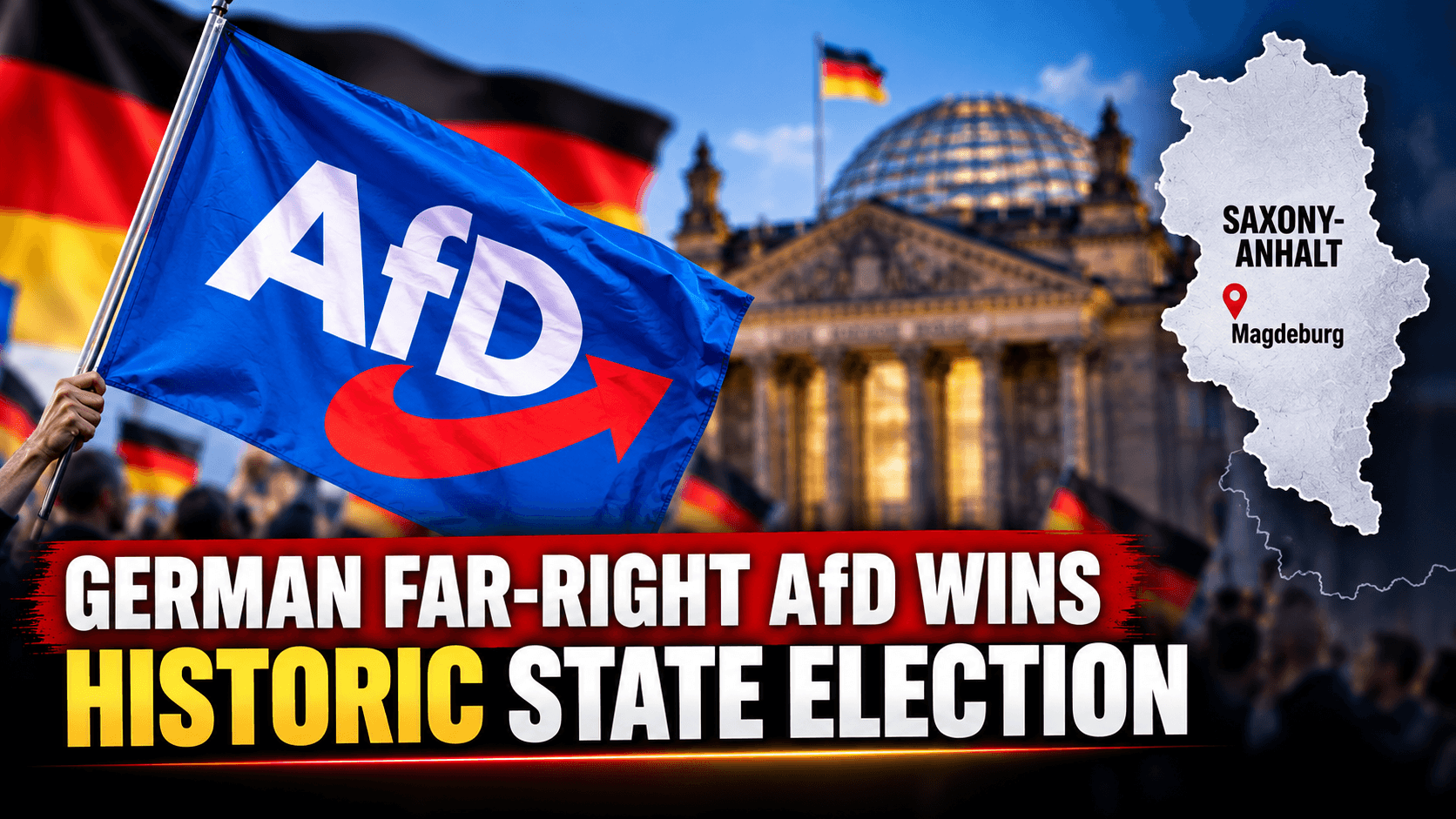
German Far-Right AfD Wins Historic State Election in Saxony-Anhalt
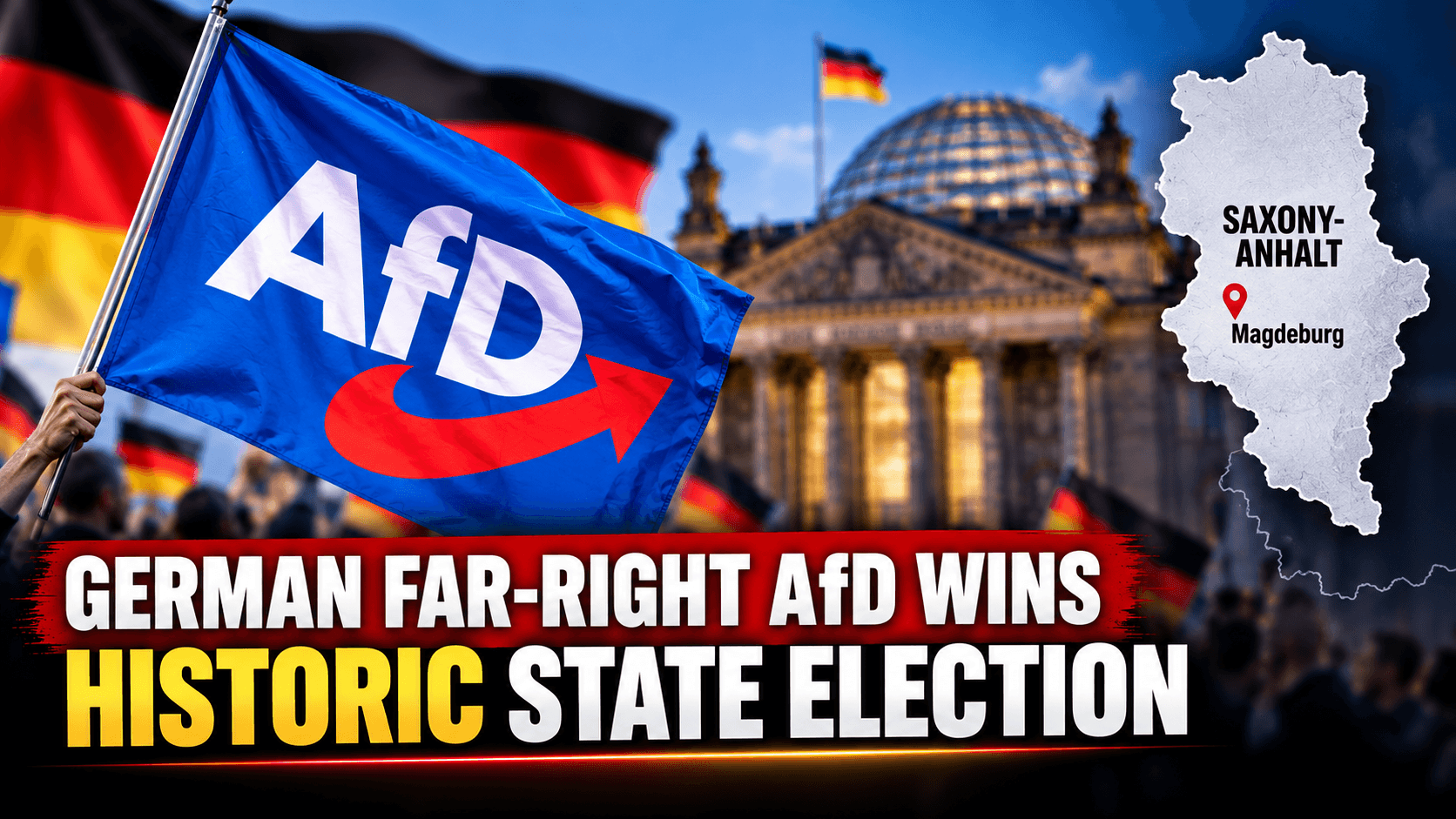
Magdeburg, September 7, 2026: Germany's far-right Alternative for Germany (AfD) has achieved a historic victory in the state election in Saxony-Anhalt, winning roughly 44% of the vote and becoming the strongest political force in the eastern German state.
The result represents the AfD's strongest performance in a German state election and marks a dramatic increase from the 20.8% it received in Saxony-Anhalt in 2021. Official state election figures put the AfD at about 44.2% in the latest count, while the centre-right Christian Democratic Union (CDU) received approximately 17.1%.
AfD Falls Short of an Outright Majority
Despite its commanding lead, the AfD did not win enough seats to govern alone.
The party secured 39 seats in the 83-member state parliament, leaving it three seats short of the 42 needed for an absolute majority. This means the party will need support from other lawmakers if it wants to form a government.
The result creates a complicated political situation because Germany's mainstream parties have maintained a so-called “firewall” against cooperation with the AfD.
That leaves the CDU and other parties facing difficult negotiations over how to form a governing majority while excluding the election's strongest party.
CDU Suffers Major Defeat
The election was also a significant setback for Chancellor Friedrich Merz's CDU.
The CDU, which had previously been the dominant political force in the state, received only around 17% of the vote, a substantial decline from its 37.1% result in 2021.
The result is likely to increase pressure on the national government, particularly as the AfD attempts to translate its growing electoral support into greater political influence.
Why Did the AfD Gain So Much Support?
The AfD's campaign focused heavily on issues including immigration, economic concerns and dissatisfaction with mainstream political parties
Saxony-Anhalt is part of former East Germany and has experienced population decline, industrial changes and economic challenges over several decades. The AfD has sought to turn these frustrations into political support.
Migration has also remained one of the party's most important campaign issues, alongside criticism of Germany's established political leadership.
The result suggests that the party has expanded beyond its traditional voter base and is increasingly capable of attracting support from voters who are dissatisfied with established parties.
A Major Test for Germany's Political Firewall
The election has renewed debate over Germany's long-standing refusal by mainstream parties to cooperate with the AfD.
The party's local branch has been classified as a confirmed right-wing extremist organisation by Germany's domestic intelligence service, making cooperation with it particularly controversial.
AfD supporters argue that its electoral success demonstrates that voters want the party to have a greater role in government.
Mainstream parties, however, maintain that working with the AfD would cross an important political boundary.
The result therefore creates a difficult question: how can a government be formed in a state where the strongest party is excluded from coalition negotiations?
Ulrich Siegmund Emerges as Key Figure
The AfD's campaign in Saxony-Anhalt was led by Ulrich Siegmund, a 35-year-old politician who has developed a significant following, particularly among younger voters through social media.
Siegmund celebrated the result as a historic breakthrough and has positioned the AfD as the party capable of challenging Germany's established political system.
However, his party's ability to turn its electoral victory into control of the state government remains uncertain because it does not hold a majority and other major parties have ruled out cooperation.
What Happens Next?
The immediate challenge is forming a government.
The CDU could attempt to build a coalition with the SPD and Greens, but the numbers make the process complicated. Smaller parties could become important in determining whether a stable majority can be assembled.
The AfD, meanwhile, is likely to use its historic result to demand a larger role in state politics and argue that excluding it from government would ignore the choice made by voters.
The outcome also has significance beyond Saxony-Anhalt. Germany is closely watched across Europe because of its history with political extremism and its postwar system of safeguards designed to protect democratic institutions.
A Turning Point in German Politics
The AfD's roughly 44% result represents a major transformation in Saxony-Anhalt's political landscape.
The party has more than doubled its vote share since 2021 and demonstrated that it can become the dominant electoral force in a German state. Yet winning an election and forming a government are two different challenges.
With the AfD short of an outright majority and mainstream parties maintaining their political firewall, Saxony-Anhalt now enters a period of difficult coalition negotiations.
The outcome will be closely watched across Germany as a potential indicator of how the country's political landscape could develop ahead of future elections.
Get More News on Swaggbuzz
Author
About the author
Siddhaanth Raghav
Topics