
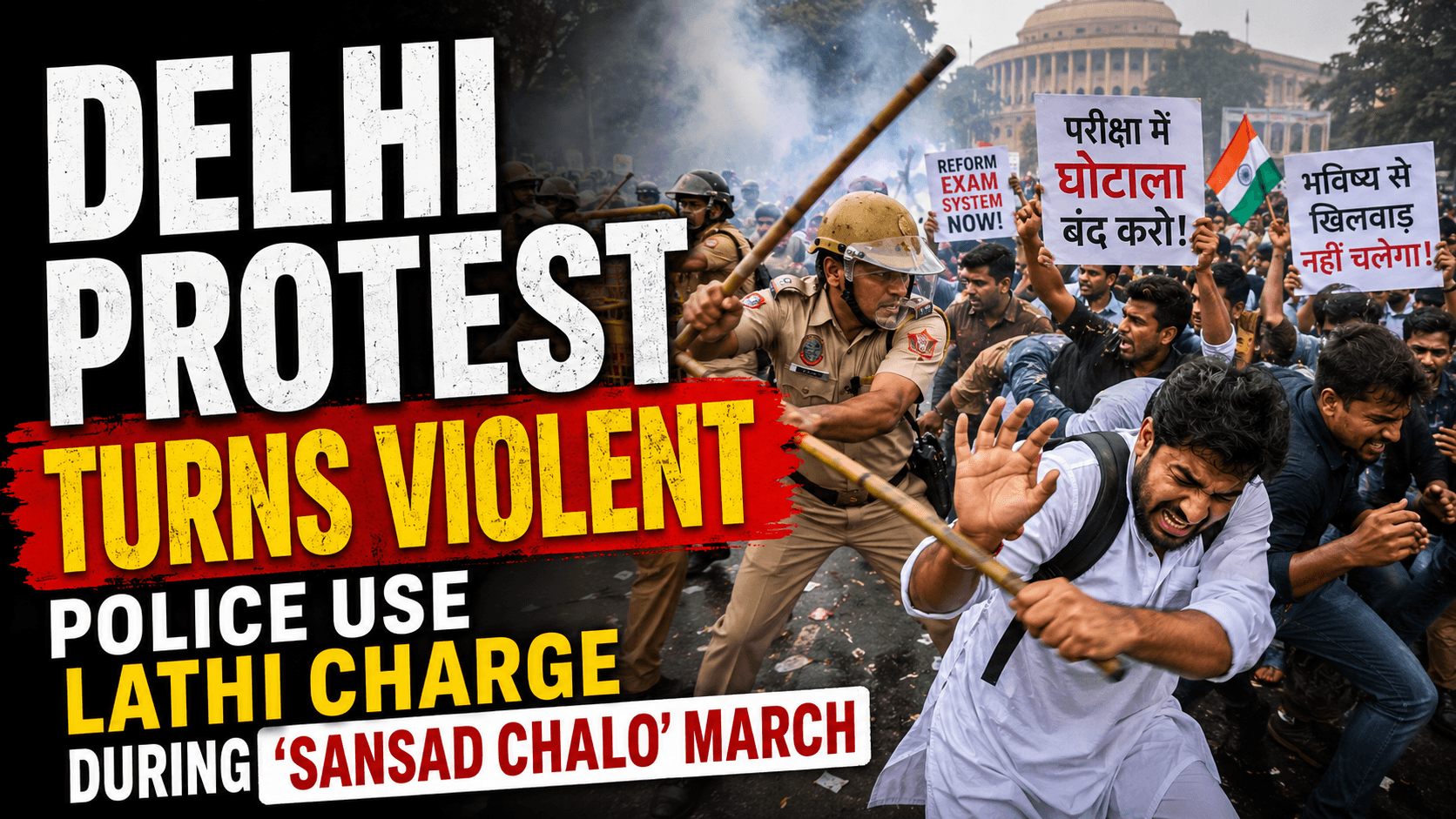
Delhi Protest Turns Violent as Police Use Lathi Charge During
Thousands of protesters gathered in New Delhi on Monday as the Cockroach Janta Party (CJP) organized its "Sansad Chalo" march, demanding action over alleged examination irregularities and calling for the resignation of Union Education Minister Dharmendra Pradhan.
Siddhaanth Raghav
Delhi Protest Turns Violent as Police Use Lathi Charge During ‘Sansad Chalo’ March
Thousands of protesters gathered in New Delhi on Monday as the Cockroach Janta Party (CJP) organized its "Sansad Chalo" march, demanding action over alleged examination irregularities and calling for the resignation of Union Education Minister Dharmendra Pradhan. What began as a large demonstration at Jantar Mantar soon escalated into violent clashes after protesters attempted to march toward Parliament despite heavy security restrictions.
Delhi Police used lathi charges, tear gas, and other crowd-control measures to stop demonstrators from advancing, leading to widespread chaos in the Parliament Street area. Videos of the clashes quickly spread across social media, drawing national attention to the confrontation.
Protesters Attempt March Towards Parliament
The demonstration attracted thousands of students, youth activists, and supporters from across the country. Protesters marched from Jantar Mantar toward Parliament, demanding reforms to India's public examination system and accountability for alleged paper leaks.
Security had been significantly tightened around Parliament because the Monsoon Session was underway. Multiple barricades were installed, and large numbers of Delhi Police and Rapid Action Force personnel were deployed to prevent protesters from entering restricted areas.
Police Resort to Lathi Charge
As demonstrators pushed against police barricades, clashes erupted between protesters and security personnel.
According to Delhi Police, officers used lathi charges and tear gas after protesters attempted to breach barricades and move into prohibited zones. Authorities stated that the measures were taken to maintain law and order and protect high-security government areas.
Protest organizers, however, alleged that police used excessive force against demonstrators, describing the crackdown as disproportionate. Images and videos circulating online showed protesters running from tear gas, police carrying out baton charges, and several injured participants receiving medical assistance.

Injuries and Detentions Reported
The confrontation resulted in injuries on both sides.
Officials said nearly 180 people ncluding police personnel and protesters, were injured during the clashes. 70 protesters were detained, while multiple FIRs were registered in connection with alleged violence and vandalism during the march.
Emergency medical teams and ambulances were deployed as injured individuals were taken to nearby hospitals for treatment.
Protesters Continue Their Demands
Despite the police action, protest leaders vowed to continue their movement through peaceful demonstrations.
The group's demands include:
- Action against alleged examination paper leaks.
- Greater transparency in competitive examinations.
- Accountability for officials responsible for examination management.
- Resignation of Union Education Minister Dharmendra Pradhan.
- Broader reforms to strengthen India's public examination system.
Leaders said discussions with government representatives would continue but maintained that the protest would not end until concrete action is taken.
Government Responds
Following the clashes, senior government representatives met with members of the protest movement in an attempt to ease tensions.
Prime Minister Narendra Modi also called for a "foolproof" public examination system, acknowledging public concern over examination integrity while highlighting ongoing government efforts to address the issue. Protest leaders welcomed the acknowledgment but said further reforms and accountability remained necessary.
Debate Over Protest and Public Order
The incident has reignited debate over the balance between the constitutional right to peaceful protest and the responsibility of authorities to maintain public order around sensitive government institutions.
Civil society groups have called for an impartial review of the events, while human rights organizations urged restraint from all sides and emphasized the importance of protecting peaceful assembly.
Conclusion
The "Sansad Chalo" protest has become one of the largest youth-led demonstrations in recent years, placing examination reforms and government accountability at the center of national debate. While the lathi charge and clashes intensified tensions in the capital, dialogue between protest representatives and government officials is expected to continue.
As investigations proceed and political reactions unfold, the events in Delhi are likely to shape the ongoing discussion around examination reforms, public protests, and the relationship between citizens and the state.
Get More News on Swaggbuzz