

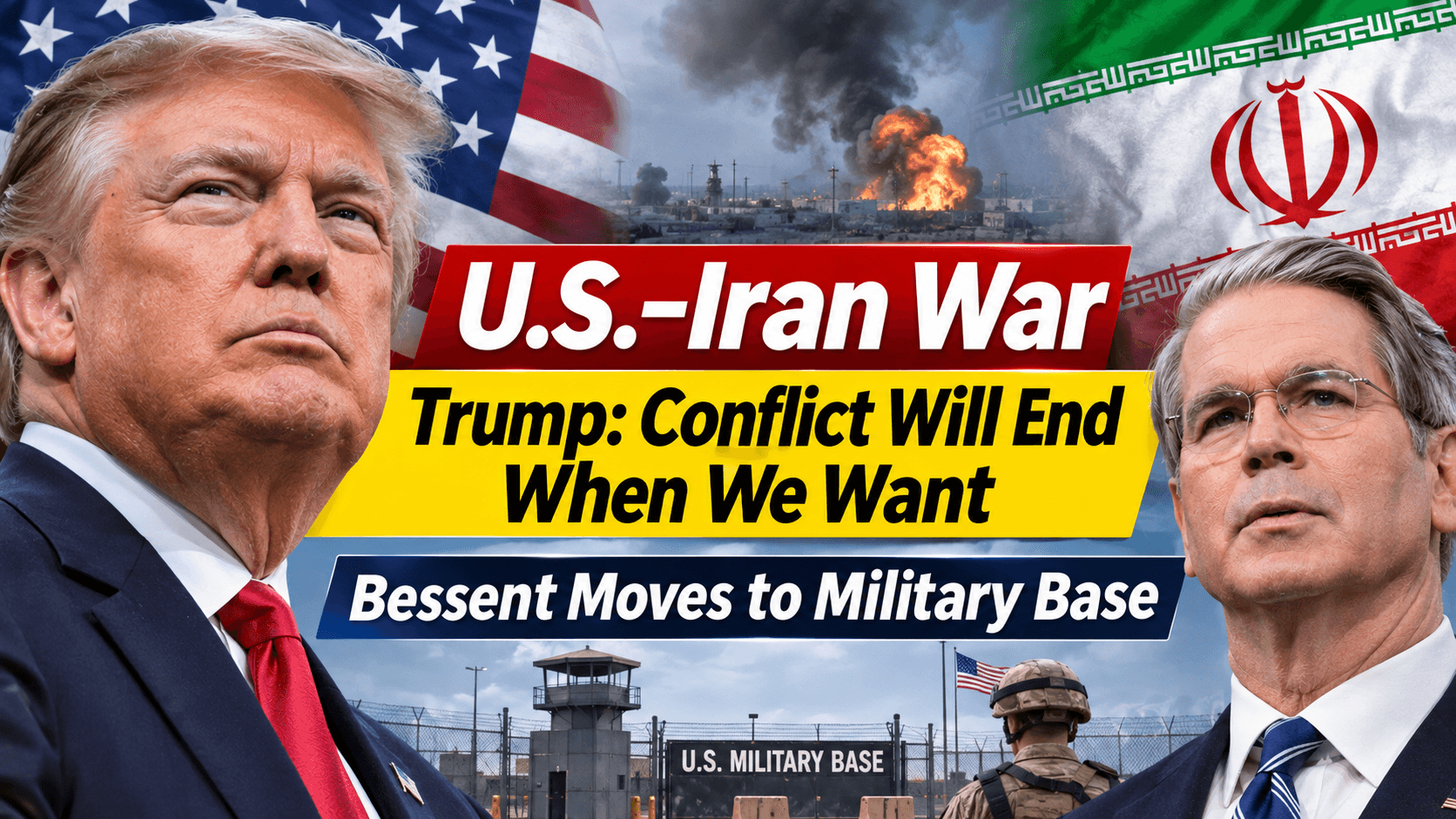
U.S.–Iran War Developments: Trump Says Conflict Will End When America Wants as Scott Bessent Relocates to Military Base
The ongoing conflict between the United States and Iran has entered another significant phase following fresh statements from President Donald Trump and reports of heightened security measures involving senior American officials.During his Veterans Day address at Arlington National Cemetery on November 11, 2026, Trump said that the war with Iran would end when the United States decided to bring it to a close. His remarks came as questions continued over the conflict's duration, diplomatic prospects, and broader security implications.
Meanwhile, U.S. Treasury Secretary Scott Bessent has reportedly relocated from his Washington-area residence to a military base following threats linked to Iran, according to multiple media reports.
Trump Says U.S.–Iran War Will End on American Terms
Speaking during the Veterans Day ceremony, President Trump defended the US military campaign against Iran and claimed that American forces had already achieved a victory.
Trump stated that the conflict's conclusion was a matter of timing, adding that the United States wanted to ensure a complete victory rather than a partial outcome.
He also argued that Iran had posed a threat to American interests for decades and said the military campaign had significantly damaged the country's capabilities.
The president indicated that the conflict could end soon, although he did not announce a specific timeline or provide details of a final agreement.
His remarks highlighted the administration's position that military objectives must be achieved before the conflict can be formally concluded.
Scott Bessent Relocates to Military Base Following Threats
In a separate development, Treasury Secretary Scott Bessent has reportedly moved from his Georgetown residence in Washington, D.C., to a military base because of security concerns.
According to reports citing people familiar with the situation, the relocation followed threats against his life attributed to Iran.
Bessent has played a central role in the Trump administration's economic pressure campaign against Tehran, including financial sanctions and measures targeting Iran's international economic relationships.
The precise nature and severity of the reported threats have not been publicly detailed.
A Treasury Department spokesperson indicated that Bessent would not be deterred by the threats and remained committed to carrying out the administration's economic policy.
U.S. Officials Face Increased Security Concerns
Bessent's relocation comes amid broader concerns about the safety of senior American government officials.
U.S. intelligence officials have reportedly warned that efforts to target American personnel have increased during the conflict.
Other senior administration officials, including Defense Secretary Pete Hegseth and Secretary of State Marco Rubio, have also been reported to reside at military installations while in Washington.
The developments have highlighted the additional security arrangements being adopted for senior government officials during the ongoing confrontation with Iran.
Economic Pressure Remains a Major Part of U.S. Strategy
Alongside military operations, the United States has continued applying economic pressure against Iran.
The Treasury Department has been involved in imposing financial restrictions and sanctions intended to limit Tehran's access to international banking networks and revenue sources.
Bessent has been one of the leading officials responsible for implementing these measures.
The administration's economic strategy is intended to increase pressure on Iran over its military activities, nuclear programme, and regional policies.
However, the wider economic consequences of the conflict have also attracted attention, particularly in international energy markets and global trade.
Iran's Nuclear Programme Remains a Major Point of Disagreement
Iran's nuclear programme continues to be one of the central issues preventing a comprehensive settlement.
The United States has maintained that preventing Iran from developing nuclear weapons remains an important objective.
Iranian officials, meanwhile, have rejected demands involving the removal of enriched nuclear material from the country.
Recent statements from Iranian security officials have raised further questions about the prospects for diplomatic negotiations.
The disagreement over nuclear material, sanctions, and security guarantees remains a major obstacle to resolving the conflict.
International Security and Diplomatic Implications
The continuing conflict has implications beyond the United States and Iran.
Countries across the Middle East are monitoring the situation because of the potential impact on regional stability, energy infrastructure, shipping routes, and international trade.
The security of the Strait of Hormuz is particularly important because it is one of the world's major routes for international oil shipments.
Any prolonged disruption could affect energy prices and supply chains in multiple regions.
Diplomatic efforts and discussions involving regional governments will remain important in determining how the situation develops.
Conclusion
The latest U.S.–Iran developments highlight the continuing military, economic, and diplomatic challenges surrounding the conflict.
President Donald Trump's Veterans Day remarks indicate that his administration is seeking a complete outcome before formally ending the war. Meanwhile, Scott Bessent's reported relocation to a military base reflects growing security concerns surrounding senior American officials.
With disagreements over Iran's nuclear programme, continuing economic pressure, and unresolved security threats, the conflict remains a major issue in international affairs.
Further developments will depend on military decisions, diplomatic negotiations, and the security situation across the Middle East.
Get More News on Swaggbuzz
Author
About the author
Siddhaanth Raghav
Topics