
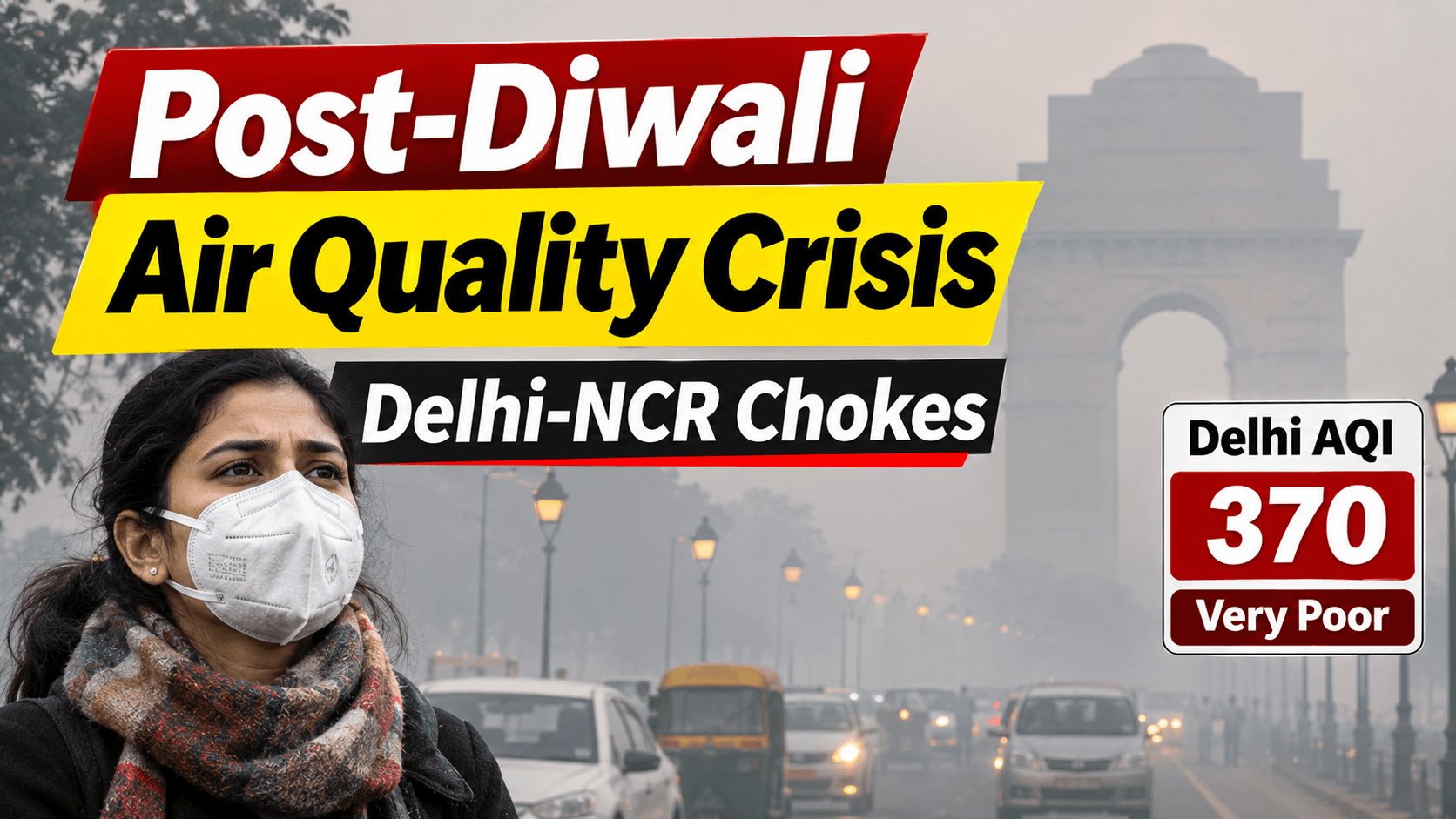
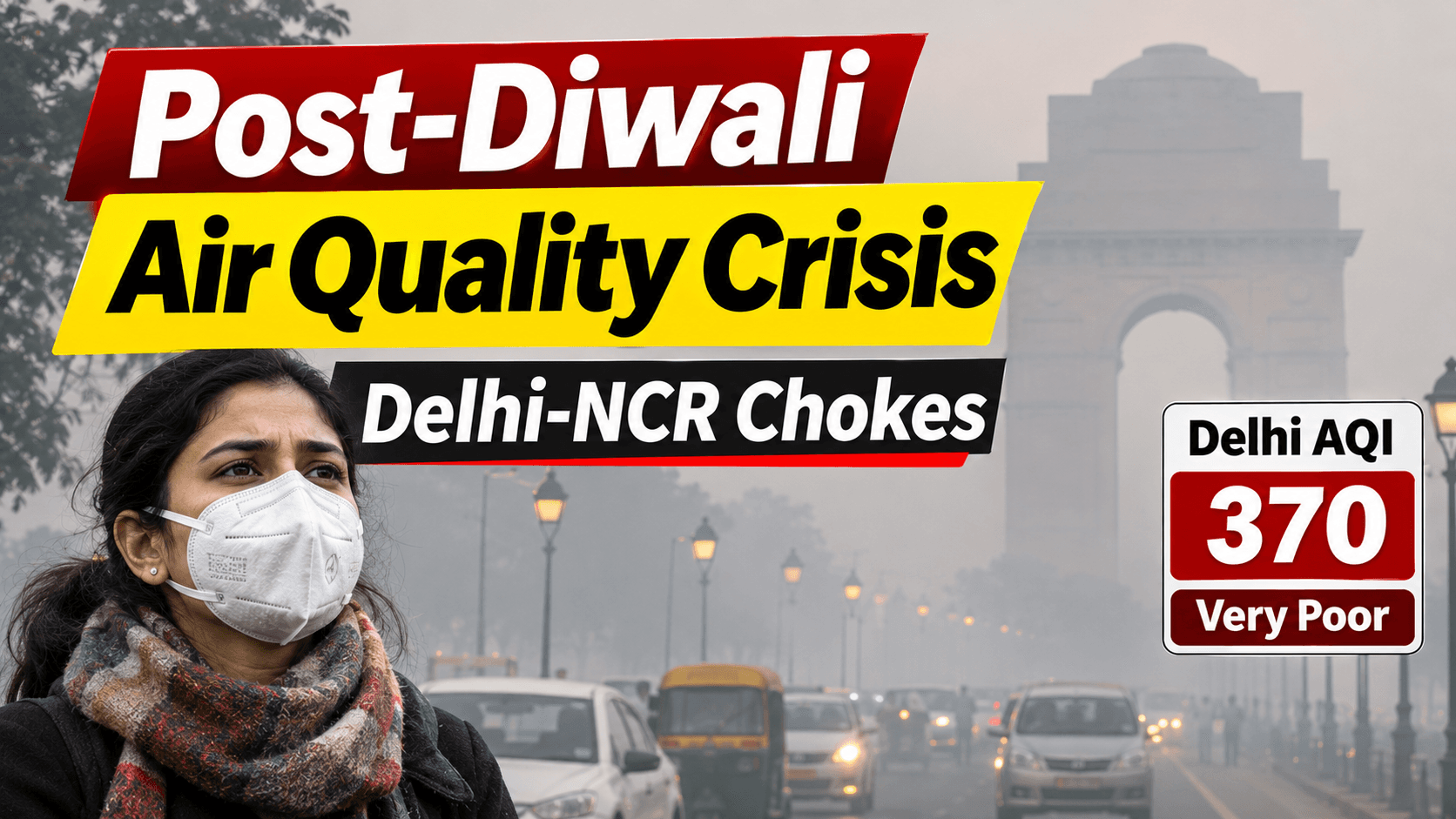
Post-Diwali Air Quality Crisis: Delhi-NCR and Major Indian Cities Struggle With Rising Pollution
Air pollution has worsened across several parts of India following Diwali celebrations, with Delhi-NCR experiencing particularly poor air quality. Firecracker emissions, agricultural stubble burning, vehicle pollution, construction dust, and unfavourable weather conditions have contributed to a thick layer of smog across several cities.
The deteriorating situation has raised public health concerns, as multiple monitoring stations in Delhi recorded air quality in the 'severe' category, while the city's overall Air Quality Index (AQI) remained in the 'very poor' range.
Delhi AQI Remains in the Very Poor Category
Delhi witnessed a significant deterioration in air quality following Diwali celebrations on November 8, 2026.
According to reported Central Pollution Control Board (CPCB) readings, the city's average AQI reached 376 on Diwali day. On November 9, the reading remained around 370, placing the capital in the 'very poor' category.
Several monitoring stations recorded AQI levels above 400, indicating severe pollution. Sonia Vihar recorded particularly high pollution levels, while other parts of the capital also experienced reduced visibility and persistent smog.
The situation has renewed concerns about the effectiveness of existing pollution-control measures during the winter season.
Firecracker Emissions Add to the Pollution Burden
Firecrackers used during Diwali celebrations have contributed additional pollutants to an already polluted atmosphere.
The burning of fireworks releases particulate matter and other pollutants that can remain suspended in the air, particularly when weather conditions prevent their rapid dispersion.
According to air-quality reports, Delhi experienced a noticeable increase in particulate pollution during Diwali night.
Fine particulate matter, particularly PM2.5, has been a major concern because these tiny particles can penetrate deep into the respiratory system.
Stubble Burning Continues to Affect Northern India
Agricultural stubble burning in neighbouring states is another important contributor to seasonal air pollution across northern India.
Farmers in parts of Punjab, Haryana, and Uttar Pradesh burn crop residue to clear agricultural fields after harvesting. The resulting smoke can travel across state boundaries and add to pollution levels in the Delhi-NCR region.
Reports indicated a substantial increase in crop-residue burning incidents across parts of northern India on Diwali.
However, pollution levels cannot be attributed to a single source. Vehicle emissions, industrial activities, construction dust, waste burning, and weather conditions also contribute to the overall situation.
Pollution Spreads Across Delhi-NCR
The post-Diwali pollution problem has extended beyond Delhi into neighbouring cities.
Areas including Noida, Greater Noida, Ghaziabad, Gurugram, and other parts of Haryana have also experienced deteriorating air quality.
On Diwali night, reported AQI readings increased in several neighbouring cities, reflecting the wider regional nature of the pollution problem.
In Haryana, Charkhi Dadri recorded an AQI of 402 on November 9, placing it in the severe category. Bahadurgarh also recorded a reading close to the severe threshold.
These developments highlight the need for coordinated pollution-control measures across the entire National Capital Region.
GRAP Restrictions and Government Measures
Authorities have continued implementing measures under the Graded Response Action Plan (GRAP) to address worsening air quality across Delhi-NCR.
Depending on the pollution category, restrictions can include:
- Limits on certain construction and demolition activities.
- Restrictions on selected polluting industrial operations.
- Measures to control dust from roads and construction sites.
- Greater monitoring of vehicle emissions.
- Restrictions on the use of certain diesel generators.
- Public advisories encouraging reduced exposure to polluted outdoor air.
Stage III GRAP restrictions were already in force across Delhi-NCR following the deterioration in air quality.
Health Concerns Associated With Poor Air Quality
Prolonged exposure to polluted air can affect respiratory and cardiovascular health.
High concentrations of particulate matter may contribute to coughing, throat irritation, breathing discomfort, and worsening respiratory symptoms.
Children, older adults, and people with existing respiratory or heart conditions can be particularly vulnerable.
Health experts generally recommend reducing prolonged outdoor exertion during periods of very poor or severe air quality.
Residents should follow official health advisories and seek medical attention if they experience significant breathing difficulties.
Why Does Pollution Become Worse During Winter?
Winter weather conditions can make India's northern cities particularly vulnerable to air pollution.
Lower temperatures, weak winds, and atmospheric conditions that limit vertical mixing can prevent pollutants from dispersing.
When emissions from vehicles, industries, agricultural activities, construction, and fireworks accumulate under these conditions, pollution concentrations can rise rapidly.
This combination makes the October-to-January period particularly challenging for air-quality management in Delhi-NCR.
Conclusion
The post-Diwali air quality crisis has once again highlighted India's continuing struggle with seasonal air pollution.
Delhi-NCR and neighbouring cities are facing elevated pollution levels due to a combination of firecracker emissions, stubble burning, transportation, industrial activity, and unfavourable weather conditions.
Although temporary restrictions and emergency measures can help manage pollution episodes, long-term improvements will require coordinated action, cleaner transportation, better agricultural residue management, industrial emission controls, and effective dust management.
As winter progresses, monitoring air quality and following official health advisories will remain important for residents across affected regions.
Get More News on Swaggbuzz
Author
About the author
Siddhaanth Raghav
Topics