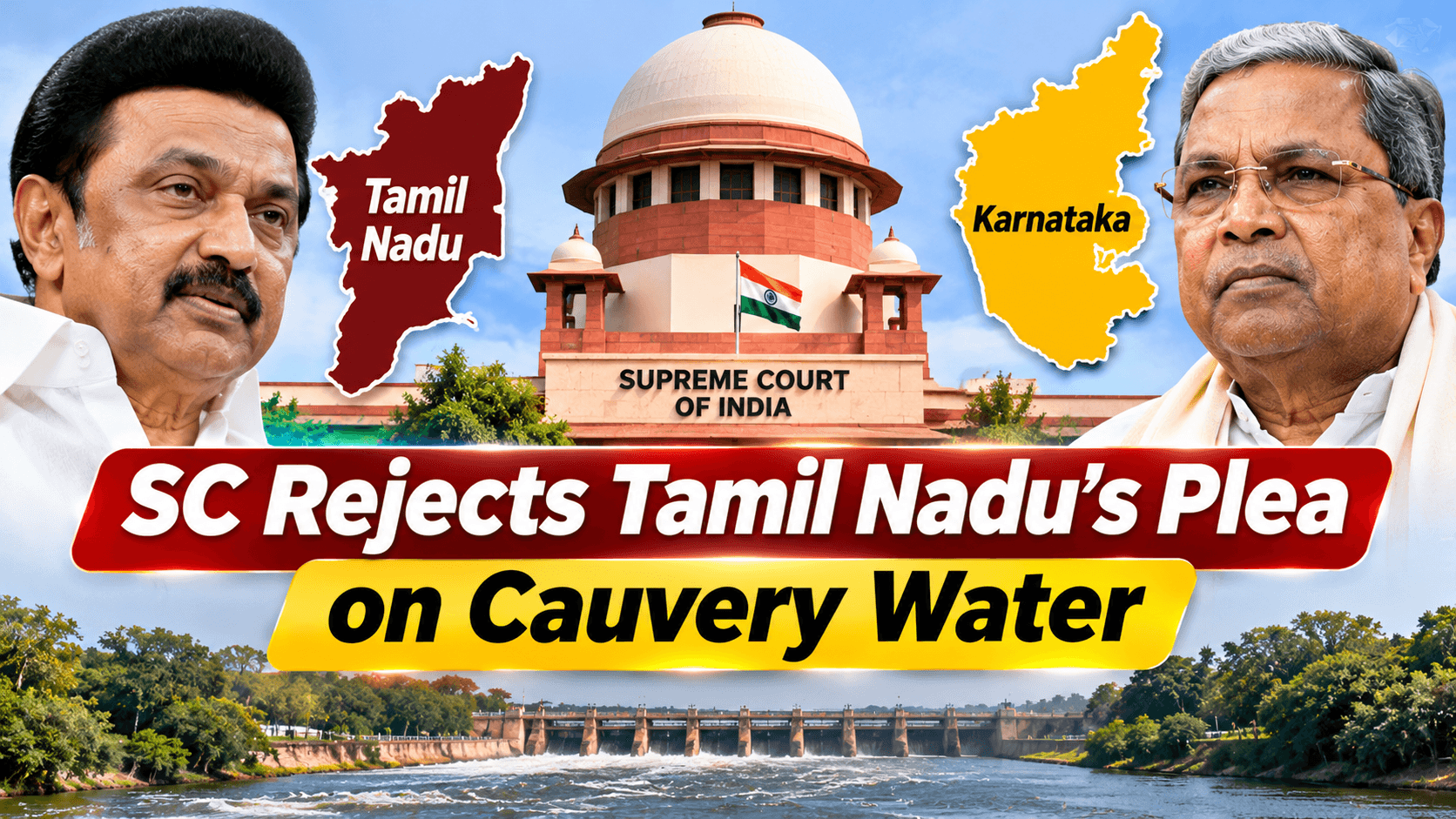
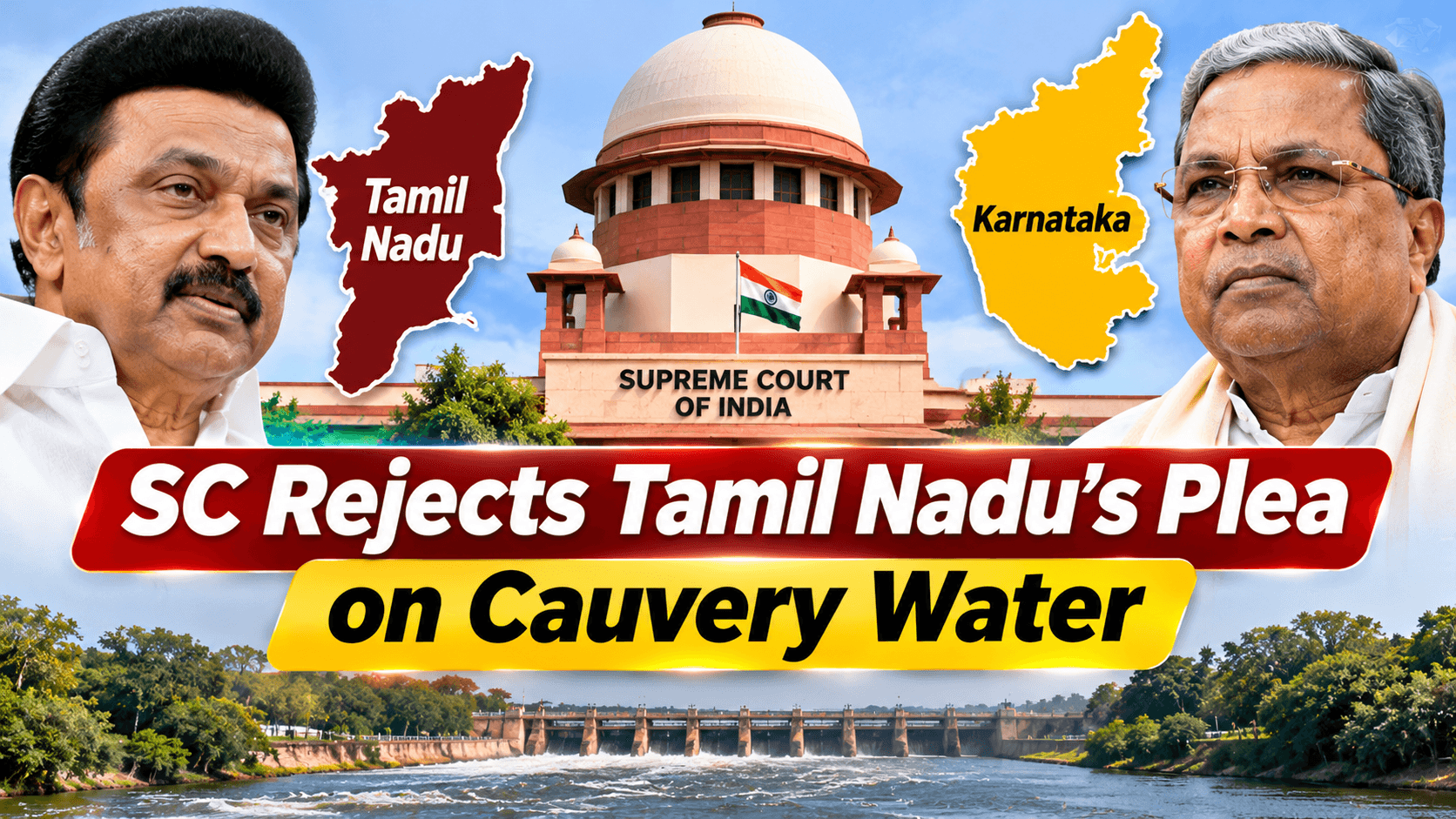
Supreme Court Rejects Tamil Nadu's Plea for Additional Cauvery Water From Karnataka
The Supreme Court of India on Friday, November 20, 2026, dismissed two applications filed by the Tamil Nadu government seeking directions to Karnataka to release an additional 11 thousand million cubic feet (TMC) of Cauvery river water. The decision marks another setback for Tamil Nadu in its long-running water-sharing dispute with Karnataka.
A bench comprising Justices Vikram Nath and Aparesh Kumar Singh rejected the state's requests, which sought the immediate release of the alleged water shortfall.
Tamil Nadu Sought 11 TMC of Additional Water
Tamil Nadu had approached the Supreme Court claiming that Karnataka had failed to release its required share of Cauvery water. The state alleged a shortfall of approximately 11.719 TMC at Billigundulu, the key water-measuring point along the Karnataka-Tamil Nadu border.
In its applications, Tamil Nadu requested the court to direct Karnataka to clear the outstanding 11 TMC backlog as of October 7. It also sought the release of approximately 1.3 TMC of water per day over 10 days.
The state argued that insufficient water supplies were affecting agricultural activities and putting farmers and crops under pressure.
Karnataka Cited Rainfall Deficit and Drought Conditions
Karnataka opposed Tamil Nadu's demand, arguing that the current year had witnessed deficient rainfall and that several regions within its own territory were facing drought-like conditions.
The Karnataka government maintained that it was following the directions issued by the Cauvery Water Management Authority (CWMA). It also highlighted the need to conserve available water to protect drinking water supplies for its residents.
The state argued that releasing the additional quantity sought by Tamil Nadu would be difficult under the prevailing water conditions.
What Is the Cauvery Water Dispute?
The Cauvery water dispute is a decades-old disagreement between Karnataka and Tamil Nadu over the sharing of river water. Kerala and Puducherry are also part of the wider water-sharing arrangement.
The dispute dates back to agreements signed in 1892 and 1924 between the erstwhile Madras Presidency and the princely state of Mysore.
The Cauvery Water Disputes Tribunal issued its final award in 2007, which was subsequently modified by the Supreme Court in its landmark 2018 judgment. The revised allocation provided 284.75 TMC to Karnataka and 404.25 TMC to Tamil Nadu, with the remaining water allocated to other basin states and environmental requirements.
The Cauvery Water Management Authority and Cauvery Water Regulation Committee oversee the implementation of the water-sharing arrangement.
Third Application Also Set to Be Dismissed
During the proceedings, the Supreme Court also noted that Tamil Nadu had filed a third application seeking to introduce additional documents into the case. The bench indicated that this application would also be dismissed.
The latest decision follows months of disagreement between the two neighbouring states over water releases, rainfall shortages and the implementation of existing water-sharing directions.
What Happens Next?
The Supreme Court's decision is likely to keep the Cauvery water-sharing issue in focus, particularly as both states face competing demands for irrigation and drinking water.
The ruling does not end the broader dispute between Karnataka and Tamil Nadu. Water releases will continue to be governed by the existing allocation framework and directions issued by the relevant water-management authorities.
Get More News on Swaggbuzz
Author
About the author
Siddhaanth Raghav
Topics