
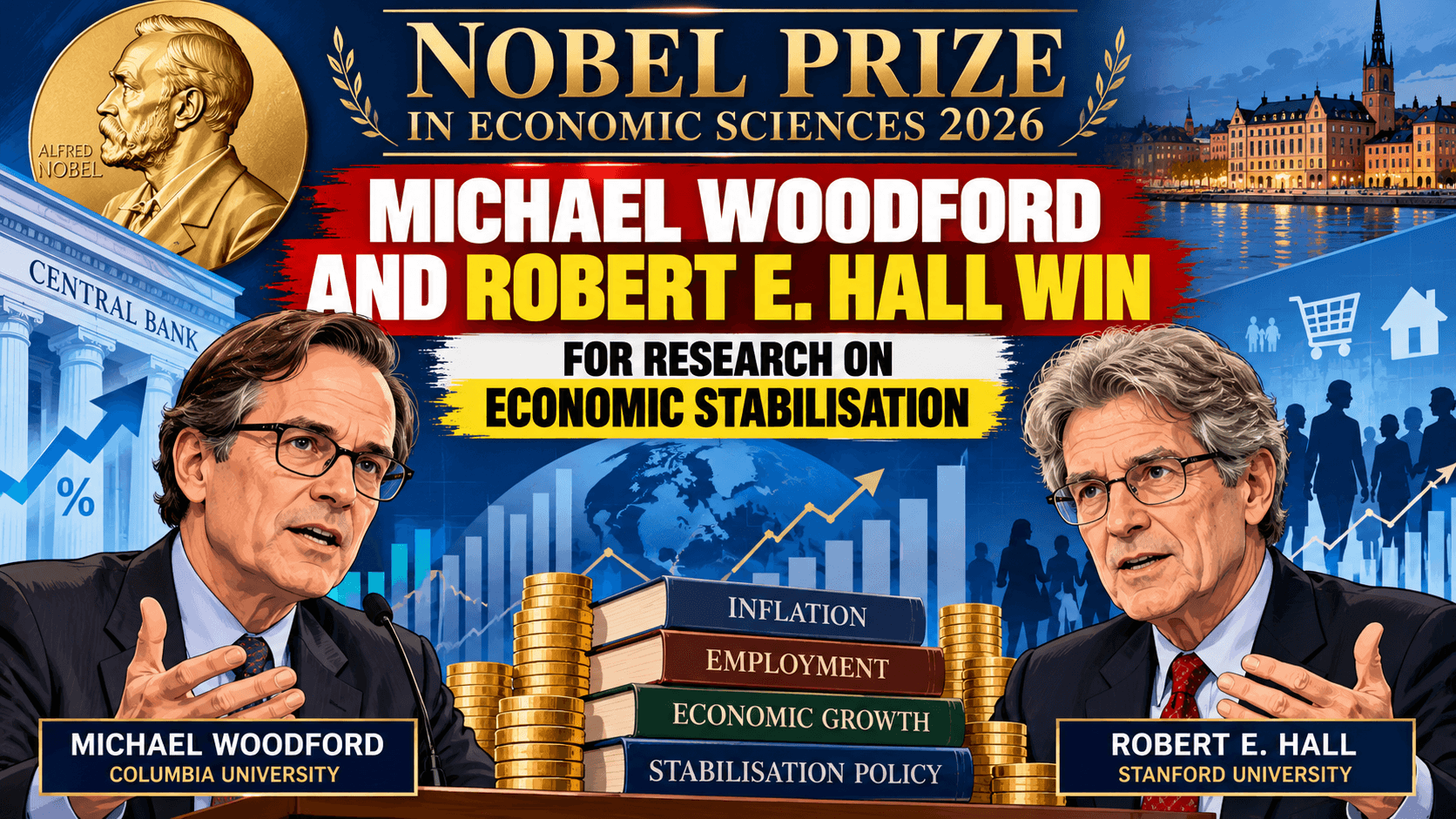
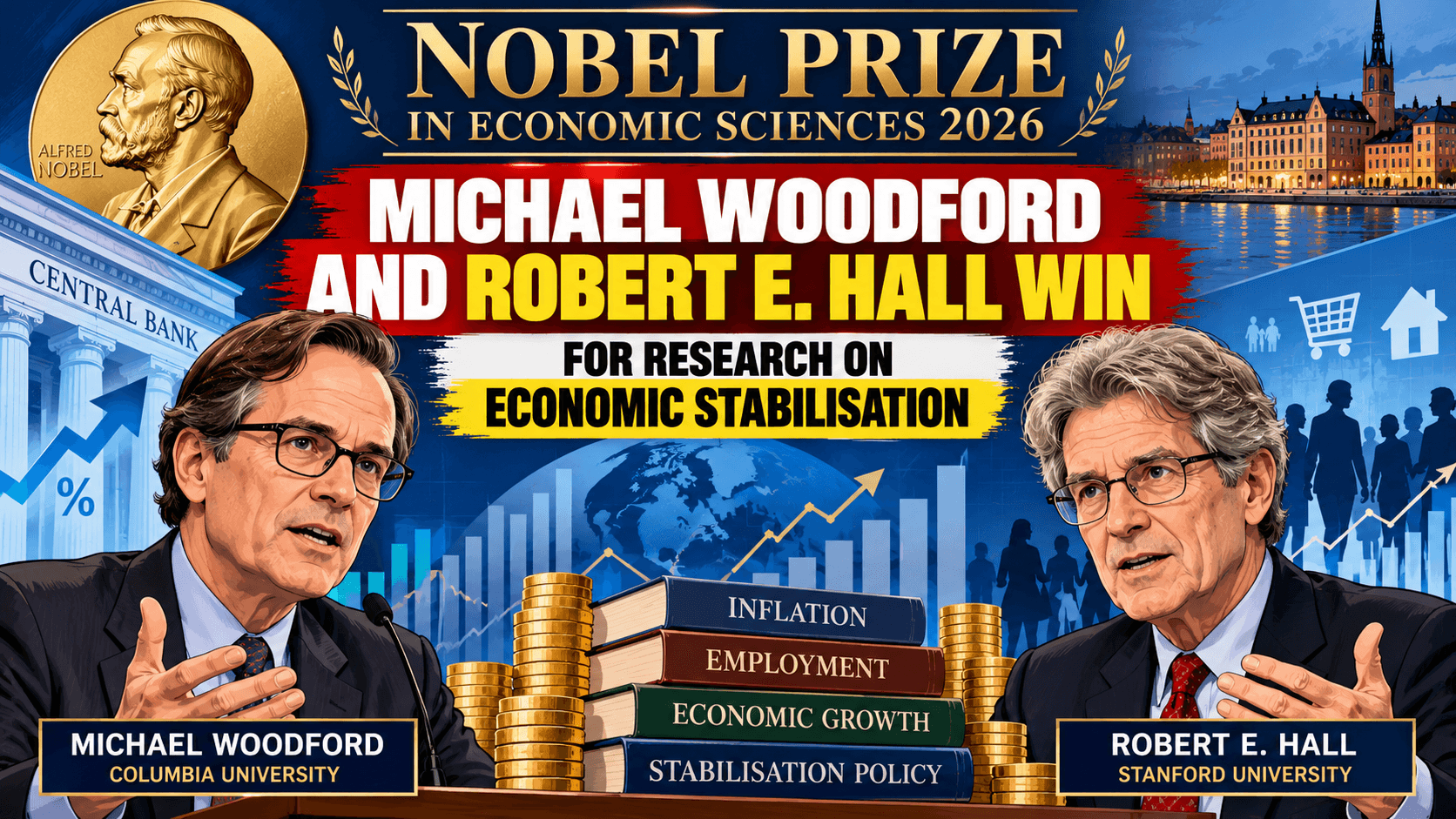
2026 Nobel Prize in Economic Sciences: Michael Woodford and Robert E. Hall Win for Research on Economic Stabilisation
Stockholm, October 12, 2026: American economists Michael Woodford and Robert E. Hall have been awarded the 2026 Nobel Prize in Economic Sciences for research that has reshaped how governments and central banks understand and manage economic fluctuations. The Royal Swedish Academy of Sciences announced the award on Monday, recognising their contributions to the “microeconomic foundations of macroeconomic stabilisation.
The economists developed theoretical frameworks that help policymakers understand how individual decisions made by households and businesses influence the wider economy. Their work has strengthened the models used to guide monetary and fiscal policy during periods of inflation, recession and other economic shocks.
Why Did Michael Woodford and Robert E. Hall Win the Nobel Prize?
The award recognises research that connects individual economic behaviour with broader developments such as inflation, employment, consumption and economic growth.
Traditional macroeconomic models often relied heavily on statistical relationships between major economic indicators. Hall and Woodford helped advance an approach that examines the decisions of individual households and businesses, including how their expectations about the future influence spending, saving, investment and pricing.
According to the Nobel announcement, this research has significantly improved the ability of governments and central banks to implement effective stabilisation policies. These policies aim to reduce sharp economic fluctuations and support more stable growth.
Michael Woodford’s Contribution to Monetary Economics
Michael Woodford is a professor of political economy at Columbia University in New York. His research has had a major influence on modern monetary economics, particularly the role of interest rates, inflation expectations and central bank communication.
Woodford’s work helps explain why monetary policy depends not only on current interest rates but also on what households, businesses and financial markets expect policymakers to do in the future.
One important concept associated with modern monetary policy is forward guidance. Through forward guidance, central banks communicate their intentions regarding the likely future direction of interest rates. Such communication can influence economic decisions even before a policy change takes effect.
These ideas have been particularly relevant when central banks have faced constraints on how far they can reduce interest rates, including during periods of economic weakness.
Robert E. Hall’s Research on Household Behaviour
Robert E. Hall is an economist affiliated with Stanford University in California. His research has contributed to the understanding of household consumption, labour markets and macroeconomic fluctuations.
Household spending is a major component of economic activity. Decisions about whether to spend income or save it can influence demand for goods and services, business investment and employment.
Hall’s work on consumption and expectations helped establish a foundation for understanding how households respond to anticipated changes in income and economic conditions. These insights also contributed to the development of broader models of how the economy functions.
Together, Hall’s and Woodford’s contributions have helped economists build more detailed explanations of how individual choices affect economic outcomes.
How Their Research Changed Stabilisation Policy
Stabilisation policy refers to the measures governments and central banks use to limit economic instability. During a recession, policymakers may reduce interest rates or increase government spending to support demand. When inflationary pressure becomes excessive, they may take steps to slow demand.
However, the effectiveness of these measures depends on how households and businesses respond. People may change their spending when they expect prices to rise, while companies may adjust investment and pricing decisions based on anticipated future demand.
The economic disruptions of the 1970s, when many economies experienced high inflation alongside weak growth and high unemployment, exposed limitations in some existing economic models.
Hall’s and Woodford’s research helped strengthen the theoretical foundations of stabilisation policy by incorporating the behaviour and expectations of economic participants. Their work has informed the development of models used by central banks and governments to assess policy decisions and economic risks.
Why the Nobel-Winning Research Matters Today
The research remains relevant as policymakers confront changing inflation rates, energy-price shocks, supply disruptions and shifts in consumer demand.
For central banks, understanding expectations can help explain why inflation may persist even after the initial cause of a price increase has eased. For governments, analysing household and business behaviour can improve assessments of how policy changes may affect consumption, employment and investment.
The models do not eliminate uncertainty or guarantee that every policy decision will succeed. Instead, they provide a stronger analytical basis for evaluating possible outcomes and understanding how economic decisions interact.
Nobel Prize Money and Background
The 2026 economics award carries a prize amount of 12 million Swedish kronor, to be shared equally between Hall and Woodford.
Formally known as the Sveriges Riksbank Prize in Economic Sciences in Memory of Alfred Nobel, the economics award was established by Sweden’s central bank in 1968 and first awarded in 1969. It is administered separately from the five original Nobel Prizes established under Alfred Nobel’s will.
The recognition of Hall and Woodford highlights the importance of economic research that connects individual behaviour with economy-wide outcomes. Their work has helped shape the analytical tools used to understand business cycles and develop policies intended to make economies more resilient to unexpected shocks.
Conclusion
The 2026 Nobel Prize in Economic Sciences recognises Michael Woodford and Robert E. Hall for helping transform the theoretical foundations of economic stabilisation. By showing how household and business decisions shape wider economic performance, their research has contributed to modern approaches to monetary policy, inflation management and economic stability.
Get More News on Swaggbuzz
Author
About the author
Siddhaanth Raghav
Topics

