
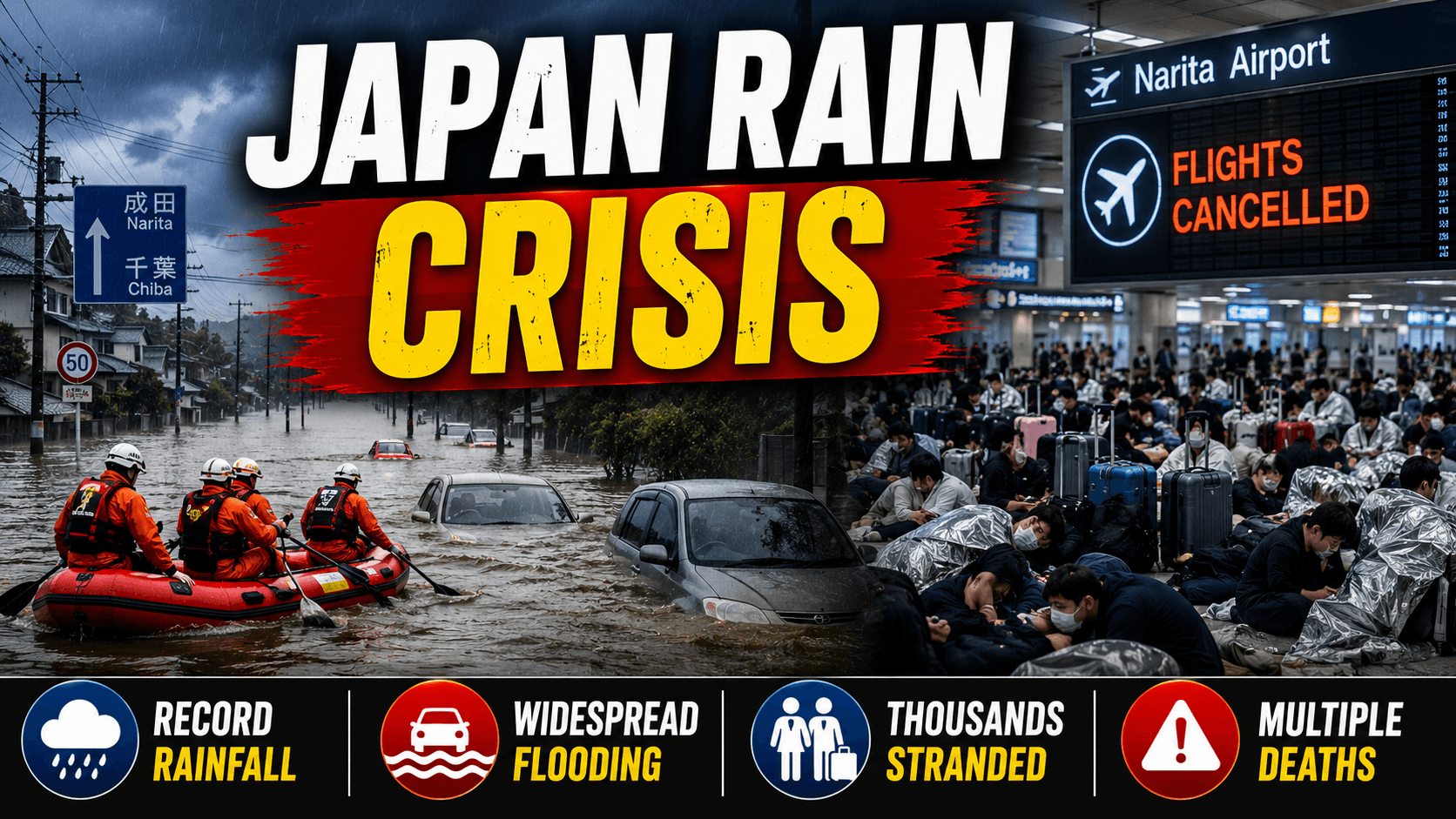
Record Downpours Flood Chiba and Strand Thousands at Narita Airport
The extreme rainfall also created major problems for travellers at Narita International Airport, where thousands of passengers were left stranded after surrounding roads and railway services were disrupted.
Siddhaanth Raghav
Japan Torrential Rain Crisis: Record Downpours Flood Chiba and Strand Thousands at Narita Airport
Japan is dealing with one of its most severe rainfall events of the year after **record-breaking downpours hit Chiba Prefecture, east of Tokyo**, causing widespread flooding, disrupting transport and forcing residents to evacuate.
The extreme rainfall also created major problems for travellers at Narita International Airport, where thousands of passengers were left stranded after surrounding roads and railway services were disrupted.
Authorities have reported multiple deaths and continued to warn residents about flooding and landslide risks as emergency teams respond to the disaster.
Record Rainfall Hits Chiba
The heaviest rainfall was recorded across parts of Chiba during Thursday and Friday.
More than 360 millimetres of rain fell in 24 hours in parts of the prefecture, while some locations experienced exceptionally intense hourly rainfall. The scale of the downpour overwhelmed drainage systems and caused rivers and waterways to rise rapidly.
The Japan Meteorological Agency issued its highest-level warnings for heavy rain and landslides in several municipalities as conditions deteriorated.
Although the most severe warnings were later downgraded as rainfall eased, officials continued to warn that flooding and landslide risks remained.
Thousands Stranded at Narita Airport
One of the most visible effects of the extreme weather occurred at Narita International Airport.
Around 7,000 travellers were stranded at the airport after flooding disrupted road and rail connections to the facility. Many passengers were unable to continue their journeys because public transportation services were suspended or heavily disrupted.
Airport staff provided stranded passengers with sleeping bags and supplies while they waited for transportation links to reopen.
The situation was particularly challenging because the heavy rain occurred during Japan's busy **Obon holiday period**, when large numbers of people were travelling across the country.
Roads and Railways Disrupted
Floodwaters covered roads and railway tracks across parts of Chiba.
Several train services were suspended, while flooded roads made it difficult for vehicles to move through affected areas. As transportation networks became overwhelmed, people were forced to remain at stations, airports and other temporary shelters.
Some train services began resuming as conditions improved, but significant delays and congestion continued.
The disruption demonstrated how quickly extreme rainfall can affect the transportation network around one of Japan's most important international airports.
Evacuation Orders Issued
Authorities issued evacuation orders and advisories across affected parts of Chiba as the risk of flooding and landslides increased.
More than 400,000 residents were reportedly ordered to evacuate at the height of the emergency. Public buildings and other facilities were used as temporary shelters for people who could not safely return home.
Emergency authorities urged residents in vulnerable areas to follow evacuation instructions and avoid travelling through flooded roads.
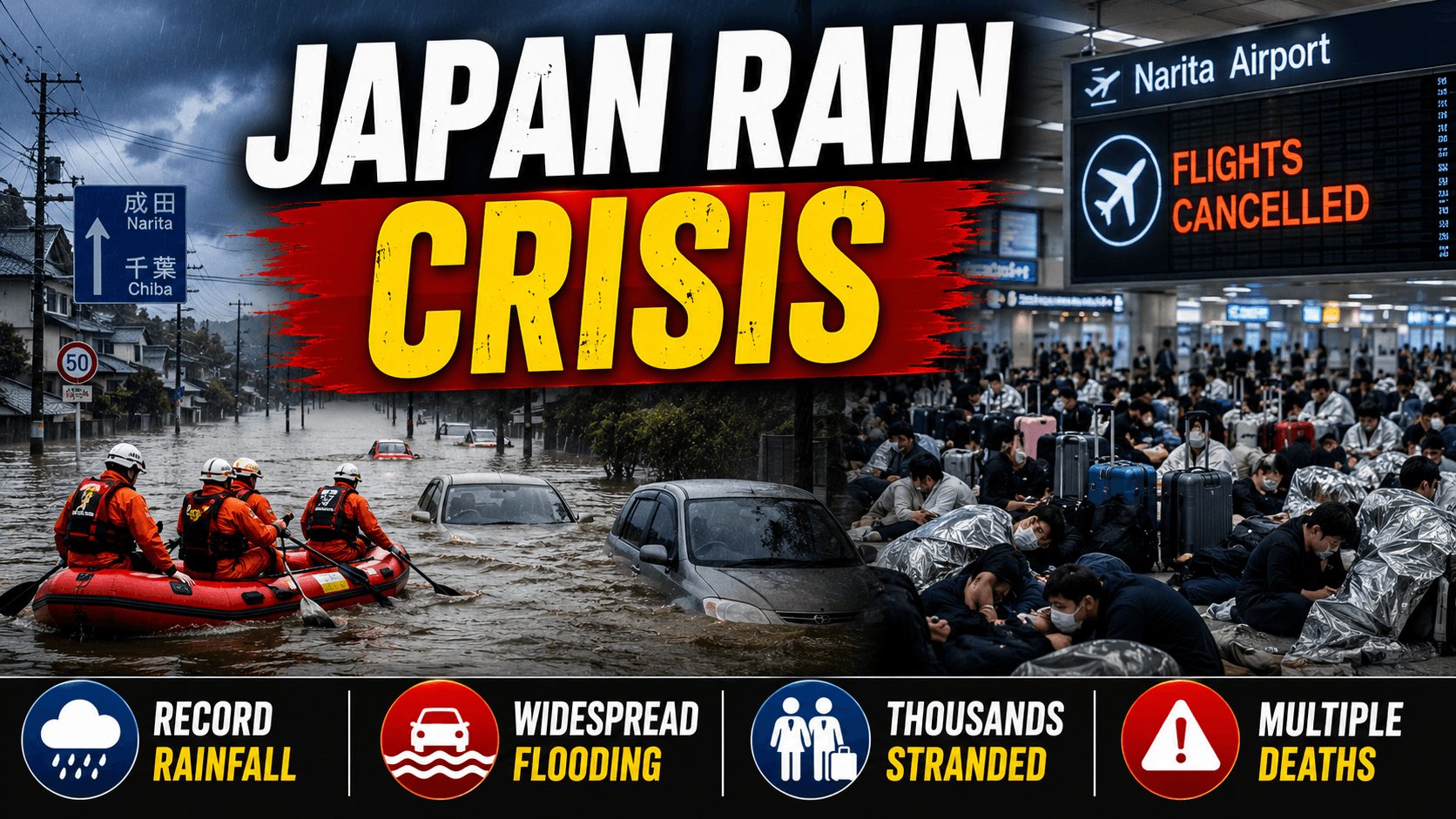
Deaths Reported as Rescue Operations Continue
The extreme weather has resulted in multiple fatalities.
Authorities initially reported four deaths, with the number subsequently rising in later updates as emergency teams assessed affected areas. Several victims were found in or near flooded vehicles and other locations affected by rising water.
The changing casualty figures reflect the ongoing nature of the rescue and recovery operation.
Emergency personnel, including members of Japan's Self-Defense Forces, were deployed to assist with relief efforts.
Power Outages Add to the Crisis
The rainfall also damaged electrical infrastructure.
Tens of thousands of homes temporarily lost electricity after flooding affected power facilities. Gas services were also disrupted for thousands of households in parts of Chiba.
Power outages added another challenge for residents already dealing with flooded homes, disrupted transportation and evacuation orders.
Why Was the Rainfall So Severe?
The rainfall was described by Japanese authorities and meteorologists as unprecedented in some affected areas.
Extremely intense rain fell over a short period, producing more water than local drainage and river systems could handle.
The event also demonstrates the vulnerability of densely populated areas to sudden extreme rainfall. Even regions with sophisticated infrastructure can experience severe disruption when rainfall intensity reaches exceptional levels.
Narita Airport Faces Major Access Problems
Narita Airport itself remained an important refuge for stranded travellers as access to the surrounding transportation network became difficult.
The airport's emergency planning specifically considers heavy rainfall scenarios in which railway and road connections can become unavailable even after aircraft operations resume.
That distinction became important during the latest event: passengers could remain stranded not necessarily because planes could not operate, but because they could not safely leave or reach the airport.
Emergency Response Underway
Japanese emergency services have been working to assist affected communities, clear transportation routes and support people who have been forced from their homes.
Shelters were opened in several locations, while emergency supplies were distributed to people unable to travel.
Authorities have also continued monitoring rivers and other waterways because flooding can remain dangerous even after rainfall begins to decrease.
Conditions Begin to Improve, But Risks Remain
Rainfall eased in parts of Chiba on Friday, allowing authorities to reduce some of the highest-level warnings.
However, officials continued to caution residents because saturated ground can increase the risk of landslides, while rivers can remain swollen after the heaviest rain has passed.
Transportation services were gradually being restored, although disruption remained significant.
A Warning About Extreme Weather
The Chiba disaster highlights the growing challenge posed by extremely intense rainfall events.
Japan has extensive experience dealing with floods, typhoons and landslides, but rainfall of this intensity can still overwhelm infrastructure and create dangerous conditions within a short period.
The impact was felt across multiple systems at once: homes were flooded, electricity supplies were disrupted, roads and railways were closed, and thousands of travellers were unable to leave Narita Airport.
Conclusion
The torrential rain in Chiba Prefecture has created a major emergency in eastern Japan, with multiple deaths, widespread flooding, evacuation orders and severe transportation disruption.
Thousands of travellers were stranded at Narita International Airport after surrounding transport links were affected, while emergency services worked to assist residents across the region.
Although rainfall has begun to ease in some areas, authorities continue to monitor flooding and landslide risks. The disaster serves as a stark reminder of how quickly record-breaking rainfall can disrupt even highly developed and densely connected urban regions.
Get More News on Swaggbuzz