
Meta Launches New AI Model Muse Glimmer as Mark Zuckerberg Pushes Open-Weight AI
Meta has unveiled a new artificial intelligence model called Muse Glimmer, stepping up its competition in the rapidly evolving AI industry while reinforcing CEO Mark Zuckerberg's push for more openly available AI technology.
Siddhaanth Raghav
# Meta Launches New AI Model Muse Glimmer as Mark Zuckerberg Pushes Open-Weight AI
New Meta AI Model Targets Local and Agentic Tasks as Company Expands Its Push Into Advanced Artificial Intelligence
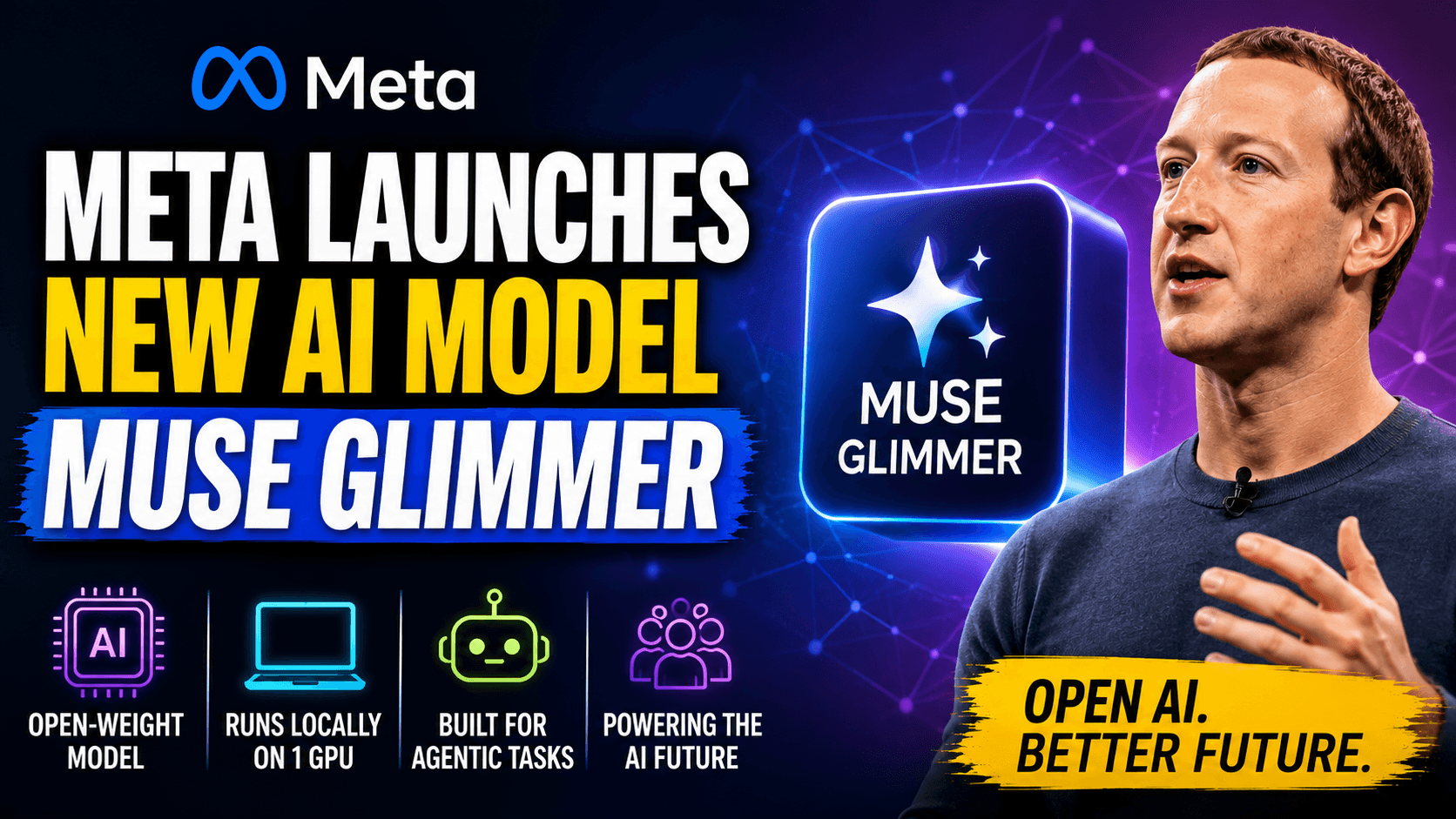
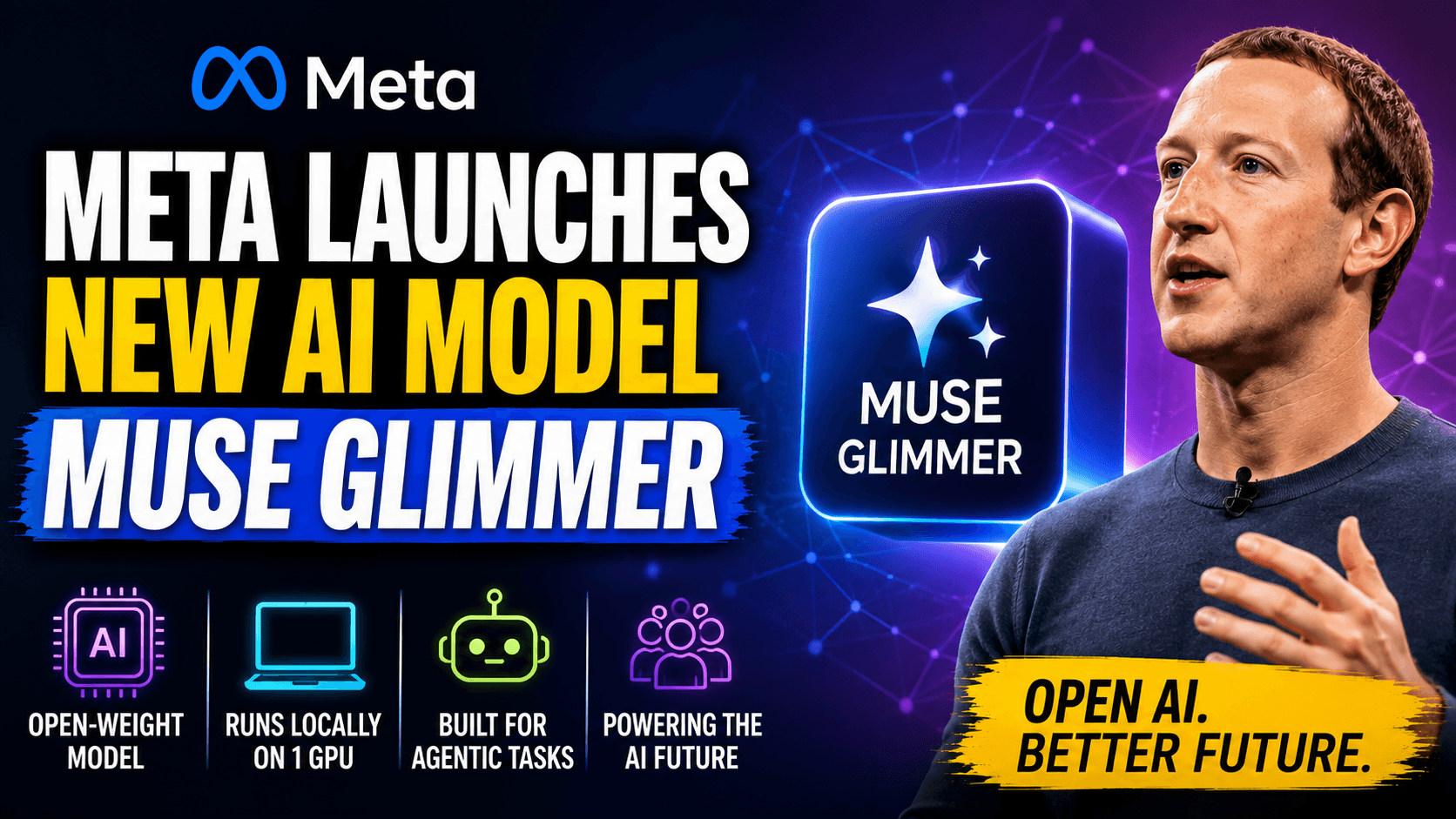
Meta has unveiled a new artificial intelligence model called **Muse Glimmer**, stepping up its competition in the rapidly evolving AI industry while reinforcing CEO **Mark Zuckerberg's** push for more openly available AI technology.
The new model is being released with its weights available to developers, allowing researchers and organizations to examine and adapt the technology rather than relying entirely on a closed AI system. Meta says Muse Glimmer is designed to handle smaller, agentic tasks and can operate locally on a computer equipped with a single graphics card.
The launch comes alongside a broader AI strategy from Zuckerberg, who has argued that advanced artificial intelligence should not be controlled exclusively by a small group of companies or institutions.
What Is Meta's Muse Glimmer?
Muse Glimmer is part of Meta's growing family of AI models.
Unlike some of the largest AI systems that require extensive cloud infrastructure, the new model is designed for smaller tasks that can potentially be performed directly on local computing hardware.
Meta's open-weight approach means developers can access the model's parameters and use them to build customized applications, subject to the applicable license terms.
The company believes this approach could make advanced AI more accessible to developers and businesses that do not want to depend entirely on large cloud-based AI services.
Designed for Local AI Tasks
One of the most notable features of Muse Glimmer is its ability to run locally using a single graphics processing unit.
Local AI can offer several advantages.
Applications do not necessarily need to send every request to a remote data center, potentially reducing latency and making some AI functions available even when internet connectivity is limited.
Local processing can also give developers greater control over how AI systems are integrated into their products.
However, the actual performance of any local AI model depends heavily on the hardware, software configuration and specific task involved.
Zuckerberg's Open AI Vision
The launch was accompanied by a major policy argument from Mark Zuckerberg.
In an essay titled **"The Future is for Everyone,"** the Meta CEO argued that advanced AI should be distributed broadly rather than concentrated among a small number of companies or governments.
Zuckerberg said open-weight AI could give individuals and businesses more control over how artificial intelligence is used.
He also argued that widespread access could encourage innovation and competition in the AI industry.
Meta Challenges Closed AI Models
Meta's strategy contrasts with companies that primarily develop proprietary AI systems.
The company has repeatedly promoted open-weight models as an alternative to highly controlled AI platforms.
Zuckerberg has argued that concentrating powerful AI technology within a small number of organizations could create risks by giving those institutions disproportionate control over an increasingly important technology.
Meta's latest release therefore represents both a technological launch and part of a broader debate about how advanced AI should be developed and distributed.
Muse Spark 1.2 Also Coming
Meta's AI ambitions extend beyond Muse Glimmer.
The company has announced plans to release **Muse Spark 1.2**, which it describes as its most advanced model yet.
The upcoming model is expected to play an important role in Meta's broader AI strategy as the company continues developing increasingly capable systems.
Meta has already integrated its Muse family into its AI products, giving the company a direct way to bring improvements in its underlying models to users across its ecosystem.
Competition in the AI Industry
Meta's announcement comes as competition among major technology companies continues to intensify.
Companies including OpenAI, Google, Anthropic and others are investing heavily in increasingly capable AI models.
The competition is taking place across several areas, including:
- AI reasoning.
- Coding.
- Autonomous agents.
- Image and video generation.
- Local AI.
- Enterprise applications.
- AI assistants.
Meta's decision to emphasize open-weight models gives it a distinct position in this increasingly competitive market.
Why Open-Weight AI Matters
Open-weight AI can allow developers and researchers to inspect and modify model parameters and build specialized applications.
This can be particularly useful for organizations that want more control over how an AI model behaves.
It can also encourage independent research and experimentation.
At the same time, releasing powerful AI models more broadly raises questions about safety, cybersecurity, misuse and responsible deployment.
These concerns have become an increasingly important part of the global debate surrounding advanced AI.
Meta's Growing AI Investment
Meta has been investing heavily in artificial intelligence and has reorganized its AI operations around its long-term goal of developing highly capable systems.
The company has recruited prominent AI researchers and engineers and has expanded its computing infrastructure to support increasingly demanding AI workloads.
Zuckerberg has described advanced AI as one of the most important technological developments of the coming years.
The latest Muse releases demonstrate that Meta intends to remain a major competitor in this field.
Concerns and Challenges
Despite the potential benefits, Meta's open-weight strategy also faces challenges.
Powerful AI models can be difficult to control once their weights are widely distributed.
Researchers and policymakers continue to debate how companies should balance openness with safeguards against misuse.
There are also questions surrounding the cost of AI infrastructure, energy consumption, privacy and the potential impact of increasingly capable AI systems on employment.
Zuckerberg acknowledged several of these issues while maintaining that the potential benefits of broadly distributed AI outweigh the risks if the technology is developed responsibly.
What This Means for AI Users
For everyday users, the significance of Muse Glimmer may not be immediately visible.
However, open-weight models can eventually influence the AI tools people use by giving developers more options to create specialized assistants and applications.
Local AI could also become increasingly important as computers and mobile devices gain more powerful AI-processing capabilities.
If Meta's strategy succeeds, more AI tasks could eventually be performed directly on personal devices rather than entirely through remote cloud systems.
Looking Ahead
Meta's latest AI announcement signals that the company is continuing to pursue an aggressive strategy in artificial intelligence.
Muse Glimmer provides developers with another open-weight option, while the planned Muse Spark 1.2 release suggests that Meta is simultaneously working on larger and more capable systems.
The company's approach will be closely watched as the technology industry debates whether the future of AI should be dominated by closed platforms or increasingly open models.
Conclusion
Meta's launch of **Muse Glimmer** represents another important step in the company's expanding AI strategy. Designed for smaller agentic tasks and capable of running locally on suitable hardware, the model reflects Meta's continued commitment to open-weight artificial intelligence.
At the same time, Mark Zuckerberg's broader argument is that advanced AI should be widely accessible rather than concentrated within a handful of powerful organizations.
With **Muse Spark 1.2** also on the horizon, Meta appears determined to compete aggressively in the next phase of the AI race. The coming months will show whether its open-weight strategy can deliver the combination of performance, accessibility and safety needed to compete with the industry's leading AI platforms.
Get More News on Swaggbuzz