

Government Approves RBI's ₹10 and ₹20 Polymer Banknote Trial
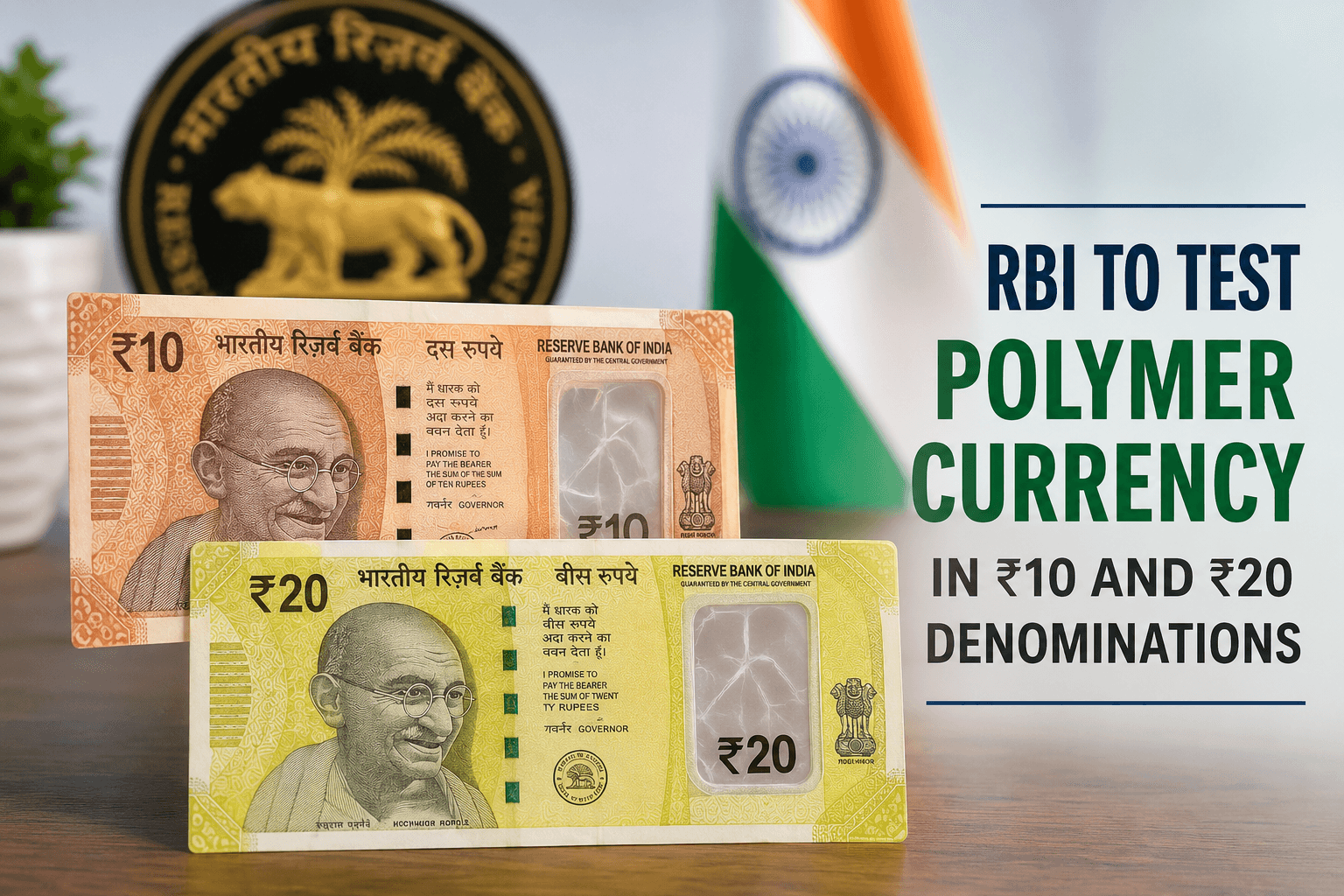
India is preparing to take a significant step toward modernizing its currency system after the Government of India approved the Reserve Bank of India's (RBI) proposal to conduct field trials of polymer (plastic) banknotes in ₹10 and ₹20 denominations.
Siddhaanth Raghav
India to Introduce Plastic Currency Notes: Government Approves RBI's ₹10 and ₹20 Polymer Banknote Trial
RBI to Test Polymer Currency in ₹10 and ₹20 Denominations; Existing Paper Notes Will Continue to Remain Valid
India is preparing to take a significant step toward modernizing its currency system after the Government of India approved the Reserve Bank of India's (RBI) proposal to conduct field trials of polymer (plastic) banknotes in ₹10 and ₹20 denominations. The initiative is aimed at evaluating whether polymer notes can offer greater durability, improved security against counterfeiting, and lower long-term printing costs compared to traditional cotton-based paper currency.
The announcement has generated widespread interest among the public, with many wondering whether India is planning to replace all paper currency. However, government officials have clarified that the move is only a pilot project and that there is no immediate plan to replace existing paper banknotes.
If the trials prove successful, polymer notes could become a regular part of India's currency circulation in the coming years.
What Are Polymer (Plastic) Banknotes?
Polymer banknotes are made from a special type of plastic substrate rather than the cotton paper traditionally used for currency.
Unlike ordinary plastic, polymer notes are designed specifically for banknote production and include advanced security features that make them more resistant to counterfeiting and everyday wear.
Many countries have adopted polymer currency because it lasts significantly longer than paper notes and remains cleaner even after prolonged circulation.
Polymer notes can also incorporate transparent windows, complex holographic elements, and advanced printing technologies that are difficult for counterfeiters to replicate.
Why Is RBI Introducing Polymer Notes?
The Reserve Bank of India has been exploring polymer banknotes for several years as part of efforts to modernize India's currency system.
The latest field trial will help authorities evaluate several factors, including:
- Durability under Indian weather conditions.
- Resistance to dirt, moisture, and humidity.
- Public acceptance and ease of use.
- Compatibility with ATMs and cash-handling machines.
- Cost-effectiveness over the long term.
- Enhanced protection against counterfeit currency.
India's climate, with high temperatures and heavy monsoon rains in many regions, often causes paper notes to deteriorate quickly. Polymer notes are expected to perform better under such conditions.
Trial Limited to ₹10 and ₹20 Notes
According to the government's approval, the RBI will initially conduct field trials using ₹10 and ₹20 polymer banknotes.
Reports indicate that approximately 2 billion notes—around 1 billion ₹10 notes and 1 billion ₹20 notes—will be printed for circulation during the testing phase.
These notes will be introduced gradually in selected regions to study how they perform under real-world conditions.
The RBI will closely monitor public feedback and operational performance before making any decision regarding wider adoption.
Existing Paper Currency Will Continue
One of the biggest misconceptions following the announcement is that all existing paper notes will soon be withdrawn.
Government officials have clarified that this is not the case.
The current ₹10 and ₹20 paper banknotes will continue to remain legal tender, and people will not need to exchange their existing currency.
The polymer notes will circulate alongside paper notes during the trial period.
Only after a detailed evaluation of the pilot project would the RBI consider expanding the use of polymer banknotes to other denominations.
Benefits of Polymer Currency
Several countries have reported positive results after adopting polymer banknotes.
Some of the key advantages include:
Longer Lifespan
Polymer notes generally last two to four times longer than paper notes, reducing replacement costs.
Better Security
Advanced security features make polymer currency significantly more difficult to counterfeit.
Water Resistance
Unlike paper notes, polymer currency does not absorb water and remains usable even in humid or wet conditions.
Cleaner Notes
The smooth polymer surface attracts less dirt and remains cleaner throughout its circulation life.
Lower Long-Term Costs
Although polymer notes cost more to produce initially, their longer lifespan often results in lower overall costs for central banks.
Countries Already Using Plastic Currency
India would join a growing list of nations that have adopted polymer banknotes.
Countries currently using polymer currency include:
- Australia (the first country to introduce polymer notes nationwide).
- Canada.
- United Kingdom.
- New Zealand.
- Singapore.
- Romania.
- Vietnam.
- Brunei.
- Nigeria (selected denominations).
- Several other countries across Asia, Europe, and the Pacific region.
The successful experience of these nations has encouraged many central banks to explore polymer technology.
Challenges RBI Will Evaluate
Despite their advantages, polymer banknotes also present certain challenges.
During the field trial, the RBI will assess:
- Printing and production costs.
- ATM compatibility.
- Public handling preferences.
- Recycling and environmental considerations.
- Storage and transportation requirements.
Feedback from banks, retailers, businesses, and consumers will play an important role in determining the future of the project.
Impact on Citizens and Businesses
For the general public, the introduction of polymer notes will not require any immediate action.
People can continue using existing ₹10 and ₹20 paper notes without any restrictions.
Banks and businesses may gradually receive polymer notes as part of regular currency circulation during the trial period.
Financial institutions will also evaluate whether existing cash-counting machines, vending systems, and ATM infrastructure require any adjustments to accommodate the new notes.
What Happens Next?
The Reserve Bank of India will begin printing and distributing polymer notes in selected locations as part of the pilot program.
After collecting sufficient data on durability, security, public acceptance, and operational performance, the RBI will prepare a detailed assessment.
Based on the findings, the central bank may decide to:
- Continue using only paper currency.
- Expand polymer notes to additional regions.
- Introduce polymer versions of higher denominations.
- Adopt a hybrid system where paper and polymer notes circulate together.
No timeline has been announced for any nationwide rollout beyond the current field trials.
Conclusion
The Government of India's approval for the RBI to conduct field trials of **₹10 and ₹20 polymer banknotes** marks an important step in the evolution of the country's currency system. While the initiative has generated excitement, it is important to note that the project is currently limited to a pilot phase, and existing paper notes will remain fully valid.
If the trials demonstrate improved durability, stronger security, and better cost efficiency, polymer banknotes could gradually become a more common feature of India's currency in the years ahead. Until then, the RBI will closely monitor the performance of the new notes before making any decision on wider implementation.
Get More News on Swaggbuzz