
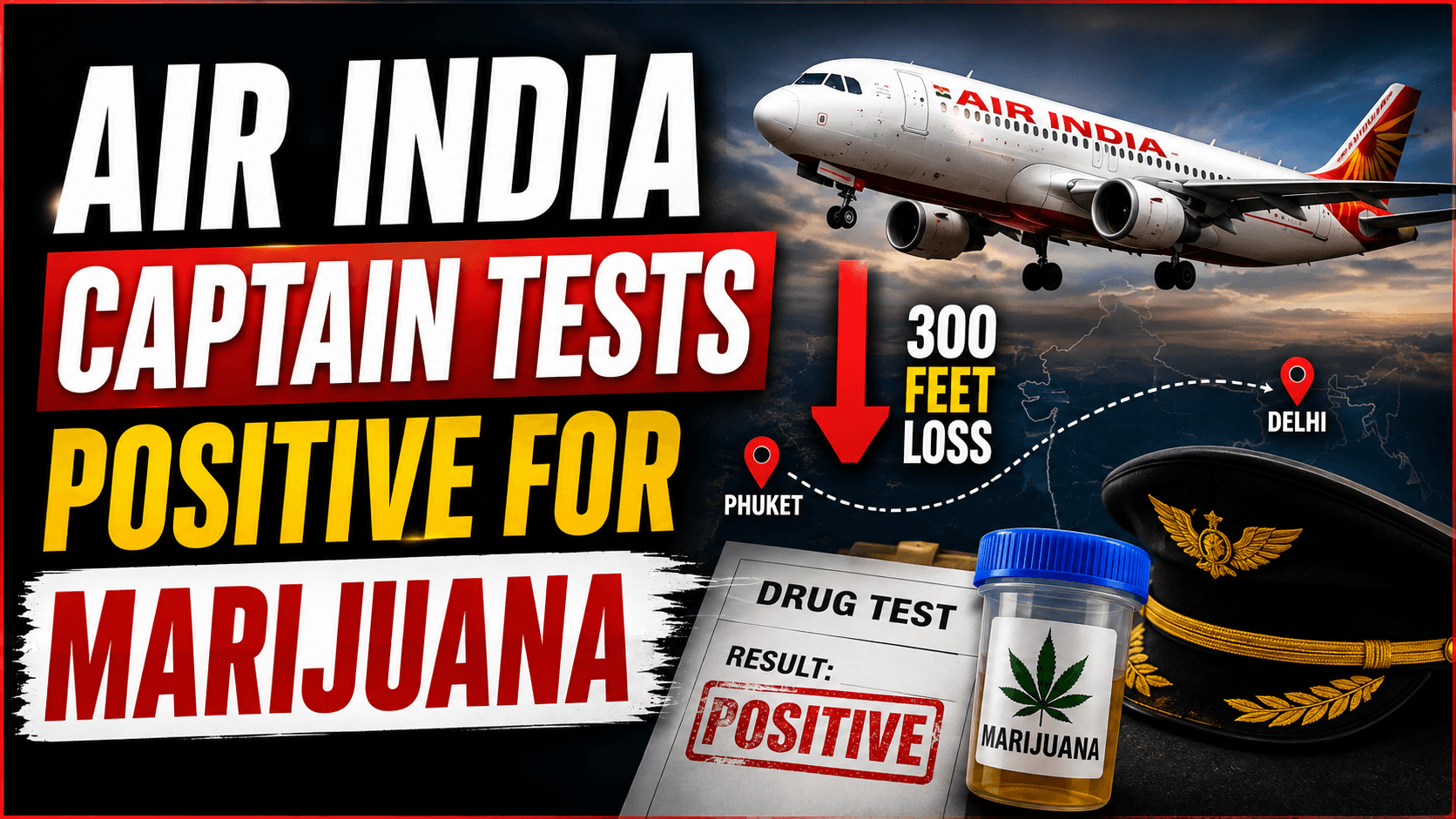
Air India Phuket-Delhi Flight Captain Tests Positive for Marijuana
The investigation into an Air India flight that unexpectedly lost around **300 feet of altitude** has taken a new turn after the aircraft's captain reportedly tested positive for marijuana in a confirmatory drug test.
Siddhaanth Raghav
Air India Phuket-Delhi Flight: Captain Tests Positive for Marijuana After 300-Foot Altitude Loss
Confirmatory Drug Test Adds New Dimension to Investigation Into Flight AI2379 Incident
The investigation into an Air India flight that unexpectedly lost around **300 feet of altitude** has taken a new turn after the aircraft's captain reportedly tested positive for marijuana in a confirmatory drug test.
The development concerns Air India flight AI2379, an Airbus A320neo operating from Phuket to Delhi*on August 4. The aircraft experienced a sudden altitude loss while flying over Odisha before stabilising and continuing toward Delhi. The flight eventually landed safely, but 13 passengers and four crew members were injured during the incident.
The positive laboratory result has prompted additional scrutiny of the incident and the airline's safety procedures. However, authorities have not established that the test result was responsible for the aircraft's sudden loss of altitude.
What Happened on the Phuket-Delhi Flight?
Flight AI2379 was carrying **137 passengers and eight crew members** when the aircraft encountered the incident during its journey from Phuket to Delhi.
The aircraft suddenly lost approximately **300 feet of altitude** while flying over Odisha. The plane subsequently stabilised and continued its journey before landing safely at Delhi airport.
The sudden movement resulted in injuries to passengers and members of the cabin crew. According to reports, 13 passengers and four crew members were injured.
The incident prompted an investigation by India's **Aircraft Accident Investigation Bureau (AAIB)**, while aviation authorities began examining the circumstances surrounding the altitude loss.
Captain's Confirmatory Drug Test
Following the incident, the captain underwent post-flight screening for psychoactive substances.
The initial screening reportedly returned a positive result, leading to a confirmatory laboratory examination.
According to a source familiar with the matter cited by Reuters, the confirmatory test subsequently returned a positive result for marijuana.
The result has become a significant part of the investigation because aviation regulations require pilots to meet strict fitness and safety standards.
The captain had reportedly already been removed from flying duties while the confirmatory testing and investigation were underway.
Positive Test Does Not Establish the Cause of the Incident
A key distinction remains important as the investigation continues.
The reported positive drug test does **not automatically prove that marijuana caused the aircraft to lose altitude**.
Investigators still need to establish what caused the sudden altitude change and whether any mechanical, environmental, operational or other factors were involved.
The aircraft was operating during a period of turbulence, and authorities are examining the overall circumstances surrounding the incident.
Therefore, the laboratory result should be viewed as a separate safety concern while the investigation into the flight itself continues.
Aviation Ministry Summons Air India CEO
The development comes as India's **Ministry of Civil Aviation** has increased scrutiny of the incident.
Air India CEO **Campbell Wilson** was summoned by the ministry on August 11 to provide information about the incident and the airline's response.
Wilson subsequently said the airline had briefed the ministry regarding the ongoing investigation.
The meeting reflects the seriousness with which Indian aviation authorities are treating the incident, particularly because passengers and crew members were injured.
Air India's Response
Air India has said it was aware that post-flight screening had taken place.
However, earlier reports indicated that the airline had not received the final confirmatory test result at that stage and therefore could not comment on it.
The airline has also indicated that it is cooperating with the relevant authorities as investigations continue.
The final findings of the investigation will be important in determining what happened during the flight and whether any additional safety measures are required.
Why Pilot Testing Matters
Commercial aviation operates under strict safety requirements because even a brief loss of aircraft control or unexpected altitude change can create risks for passengers and crew.
Pilot fitness is therefore an important part of aviation safety.
Drug and alcohol screening is designed to identify circumstances that could potentially affect a pilot's ability to safely perform their duties.
A confirmed positive result can consequently trigger regulatory and employment-related procedures, although the precise consequences depend on the applicable aviation rules and the circumstances of the individual case.
Investigation Continues
Authorities are continuing to examine the Phuket-Delhi incident.
Investigators will need to establish the sequence of events surrounding the altitude loss and determine whether the aircraft experienced any technical or operational problems.
They will also consider information from the aircraft's systems, flight data, crew reports and other available evidence.
The captain's drug-test result will form part of the wider investigation, but it should not be treated as the definitive explanation for the aircraft's behaviour before investigators reach a conclusion.
Passenger Safety Remains the Priority
The incident has renewed attention on aviation safety and the importance of maintaining strict standards throughout commercial flight operations.
The fact that the aircraft landed safely prevented the incident from becoming a much more serious accident, although the injuries suffered onboard have led authorities to investigate closely.
For passengers, the case highlights the multiple layers of safety procedures used in commercial aviation, including crew fitness checks, aircraft monitoring and regulatory oversight.
What Happens Next?
The investigation is expected to determine:
- What caused the aircraft to lose approximately 300 feet of altitude.
- Whether turbulence or another factor contributed to the incident.
- Whether any technical issue affected the aircraft.
- The significance of the captain's confirmed drug-test result.
- Whether additional regulatory or operational action is necessary.
The authorities' final findings will be important in establishing the facts.
Conclusion
The Air India Phuket-Delhi flight incident has taken a new turn after the aircraft's captain reportedly tested positive for marijuana in a confirmatory drug test.
Flight AI2379 lost around 300 feet of altitude while flying over Odisha on August 4 and later landed safely in Delhi. The incident resulted in injuries to 13 passengers and four crew members.
While the confirmed test result has intensified scrutiny of the flight's operation, it is important not to assume that it caused the altitude loss. The aviation authorities' investigation will need to establish the full sequence of events and determine the factors responsible.
For now, the captain has reportedly been removed from flying duties while the investigation continues, and the Ministry of Civil Aviation has sought an explanation from Air India's leadership.
Get More News on Swaggbuzz